

Gluten University Lesson #13
Why Can Some People Eat Bread in Europe but Not America?
Is It the Wheat… or Something Else?
Part of the Gluten University Educational Series
Gluten University Home
https://totalhealthcentervb.com/gluten-university/
Previous Lesson
https://totalhealthcentervb.com/gluten-and-leaky-gut/
Introduction
Have you ever heard someone say:
“I can eat bread in Europe without any problems, but American bread makes me feel terrible.”
It’s a surprisingly common story.
Some people return from vacations in Italy or France convinced they have discovered the secret to healthy bread.
Others dismiss the idea as nothing more than a vacation placebo.
So who’s right?
The answer is more interesting than either extreme.
The truth is that bread is far more than wheat flour. How wheat is grown, how flour is processed, how dough is fermented, what ingredients are added, and even how bread is baked may all influence how our bodies respond.
While no high-quality research proves that all European bread is healthier than American bread, there are meaningful differences in farming practices, food manufacturing, and traditional bread-making that deserve a closer look.
Is European Wheat Different?
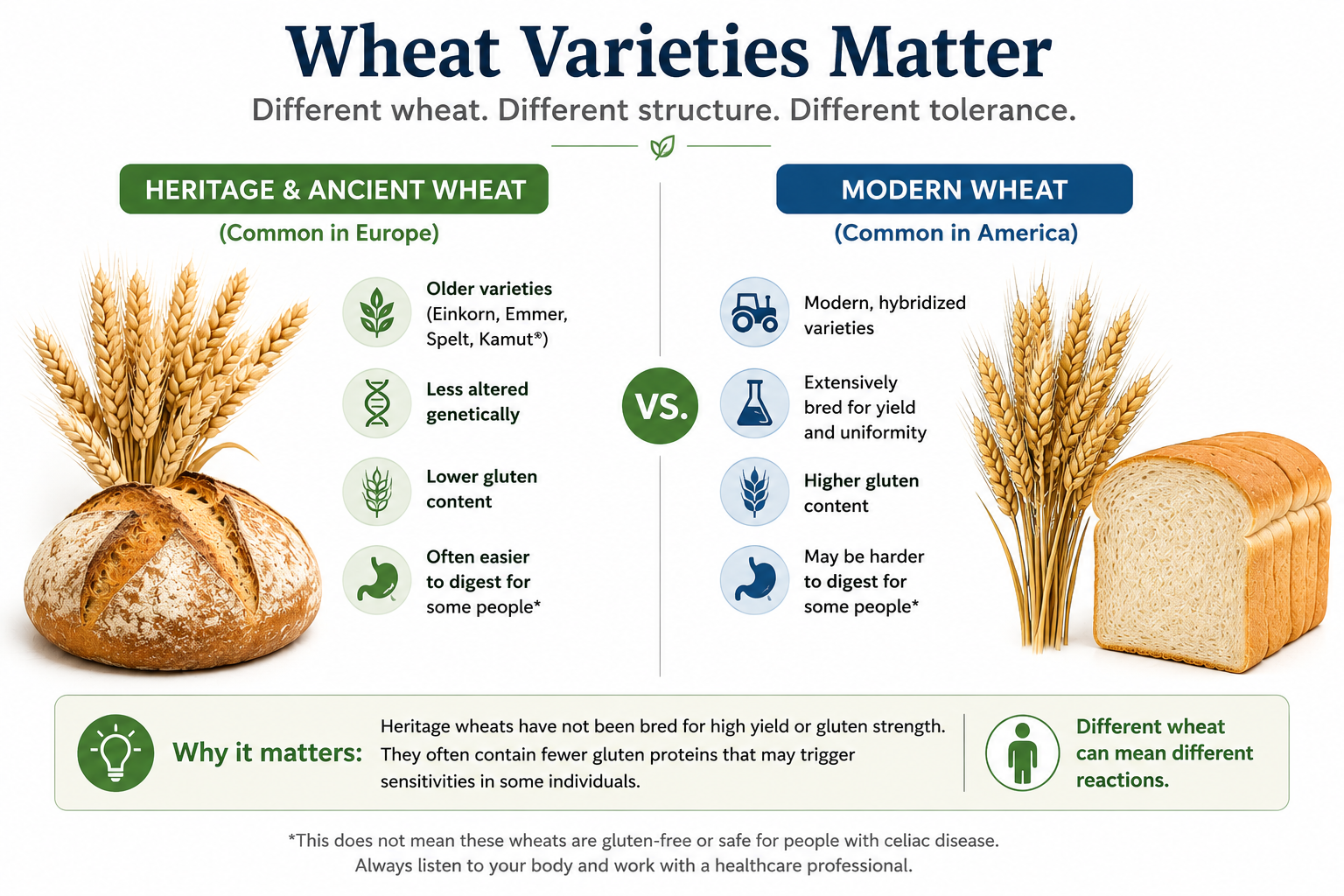
Some traditional European breads are made with heritage wheat varieties such as einkorn, emmer, spelt, or Khorasan (Kamut®), while many commercial breads are produced using modern high-yield wheat. Researchers continue to study how wheat genetics, processing, and fermentation may influence digestibility. Heritage wheat is not gluten-free and is not safe for individuals with celiac disease.
One common belief is that European wheat contains less gluten.
The reality is more nuanced.
Both Europe and North America grow several species and varieties of wheat.
Some traditional European breads are made from older wheat varieties, while many commercial breads on both continents use modern high-yield wheat.
Current evidence suggests that the way bread is produced may be more important than the country where it was made.
The Sourdough Difference
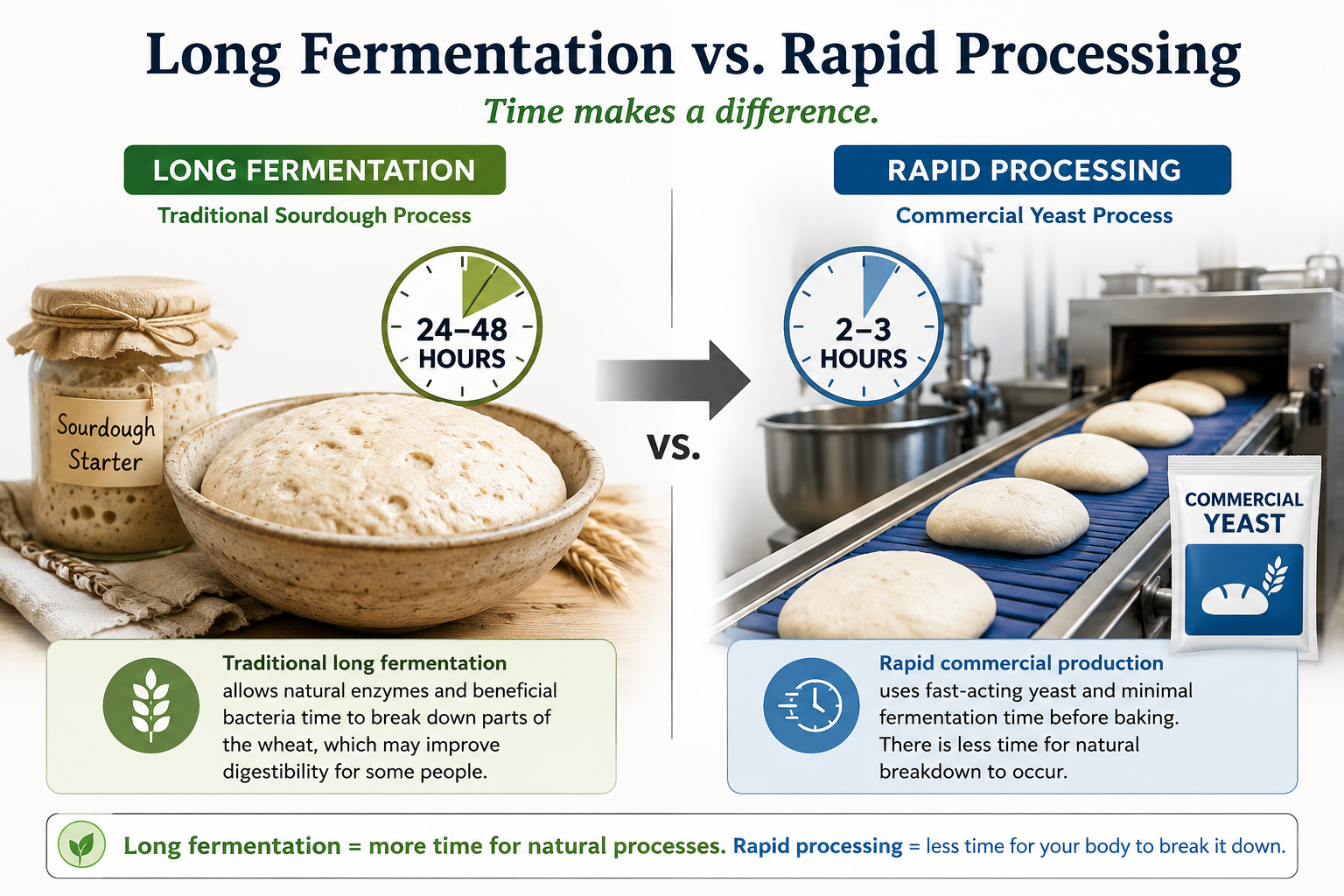
Traditional sourdough bread often ferments for 24–48 hours, while many commercial breads are produced much more quickly. Longer fermentation may begin breaking down certain gluten proteins and FODMAPs, potentially improving digestibility for some individuals. However, this does not make traditional sourdough safe for people with celiac disease.
One of the biggest differences between traditional artisan bread and many modern commercial breads is fermentation time.
Traditional sourdough breads may ferment for 24 to 48 hours.
During this process, naturally occurring bacteria and yeast begin breaking down:
- Some gluten proteins
- FODMAP carbohydrates
- Other components that may contribute to digestive discomfort
This does not make sourdough safe for people with celiac disease.
However, longer fermentation may explain why some individuals tolerate traditional sourdough better than rapidly produced commercial bread.
If you’re interested in how gut health influences digestion and immune function, be sure to read our lesson on Gluten and Leaky Gut, where we explain intestinal permeability and zonulin in greater detail.
Ultra-Processed Bread
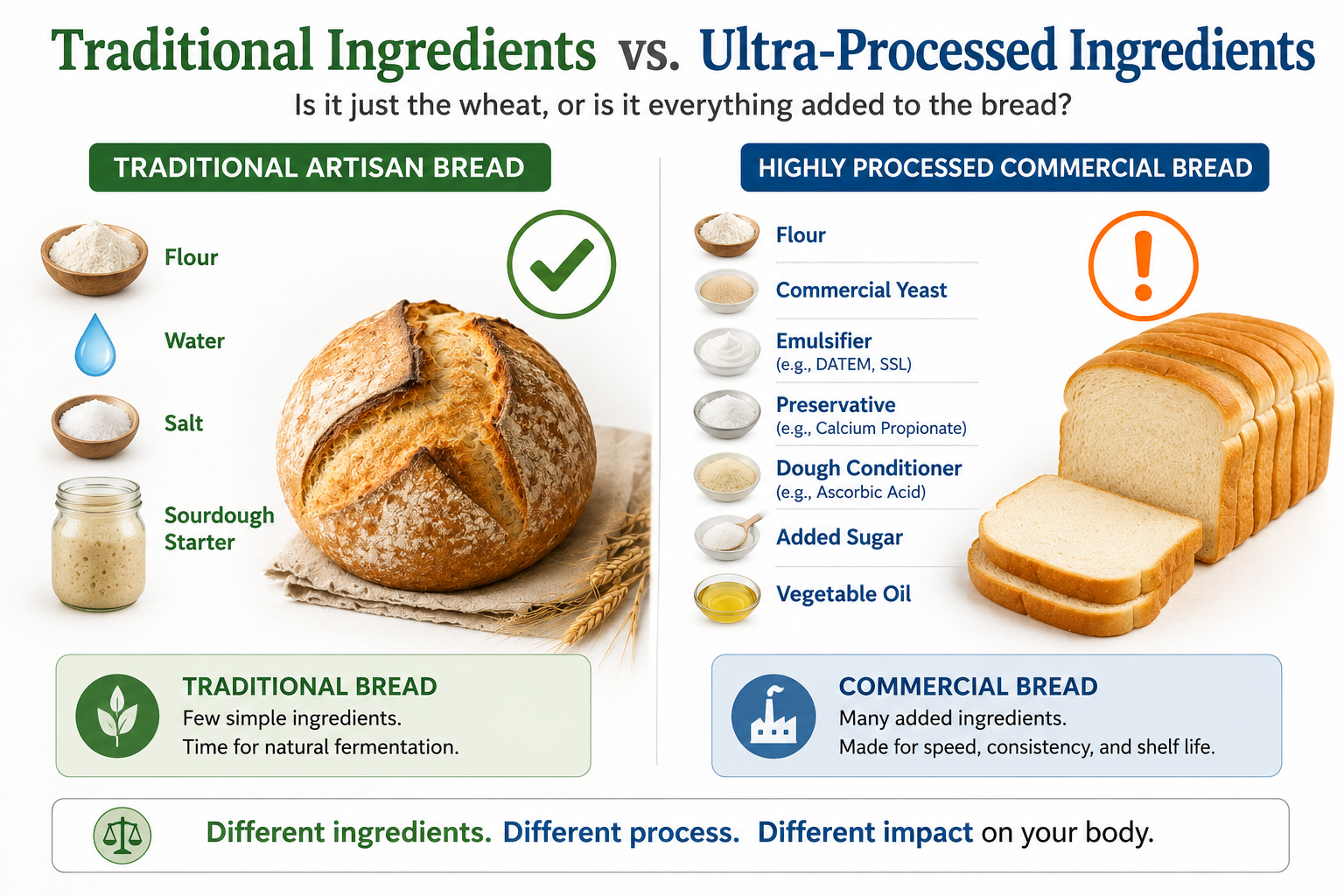
Traditional artisan bread is typically made with just a few basic ingredients—flour, water, salt, and a sourdough starter. Many commercially produced breads contain additional ingredients such as emulsifiers, preservatives, dough conditioners, added sugars, and vegetable oils to improve texture, consistency, and shelf life.
Walk through the bread aisle of most grocery stores and you’ll notice something interesting.
Many commercial loaves contain ingredients that your grandparents would hardly recognize.
In addition to flour and yeast, they may contain:
- Emulsifiers
- Dough conditioners
- Preservatives
- Added sugars
- Vegetable oils
- Artificial enzymes
- Flavor enhancers
These ingredients help create soft bread with a long shelf life, but they also make modern bread very different from the simple loaves baked for centuries.
Sometimes the issue may not be the wheat alone—it may be the overall degree of processing.
Glyphosate: Separating Fact from Speculation
Glyphosate has become one of the most controversial topics in modern agriculture.
In the United States, some wheat crops are treated with glyphosate before harvest as a drying agent, a practice known as pre-harvest desiccation.
This practice is less common or more tightly regulated in parts of Europe.
Some researchers have suggested that glyphosate exposure could influence the gut microbiome or intestinal health.
At present, however, direct evidence linking glyphosate residues in wheat to gluten sensitivity remains limited and continues to be debated.
This is an area where more high-quality research is needed.
Lifestyle May Matter Too

When people travel, it’s often more than the bread that changes. Increased walking, slower meals, lower stress, better sleep, and more time outdoors may all contribute to improved digestion and overall well-being.
There is another possibility that often gets overlooked.
People traveling through Europe frequently experience:
- Less chronic stress
- More walking
- Slower meals
- Smaller portion sizes
- Fewer ultra-processed foods
- Better sleep
- Different eating habits
All of these factors influence digestion.
Sometimes the bread gets all the credit when the entire lifestyle has changed.
It’s Probably Not Just One Thing
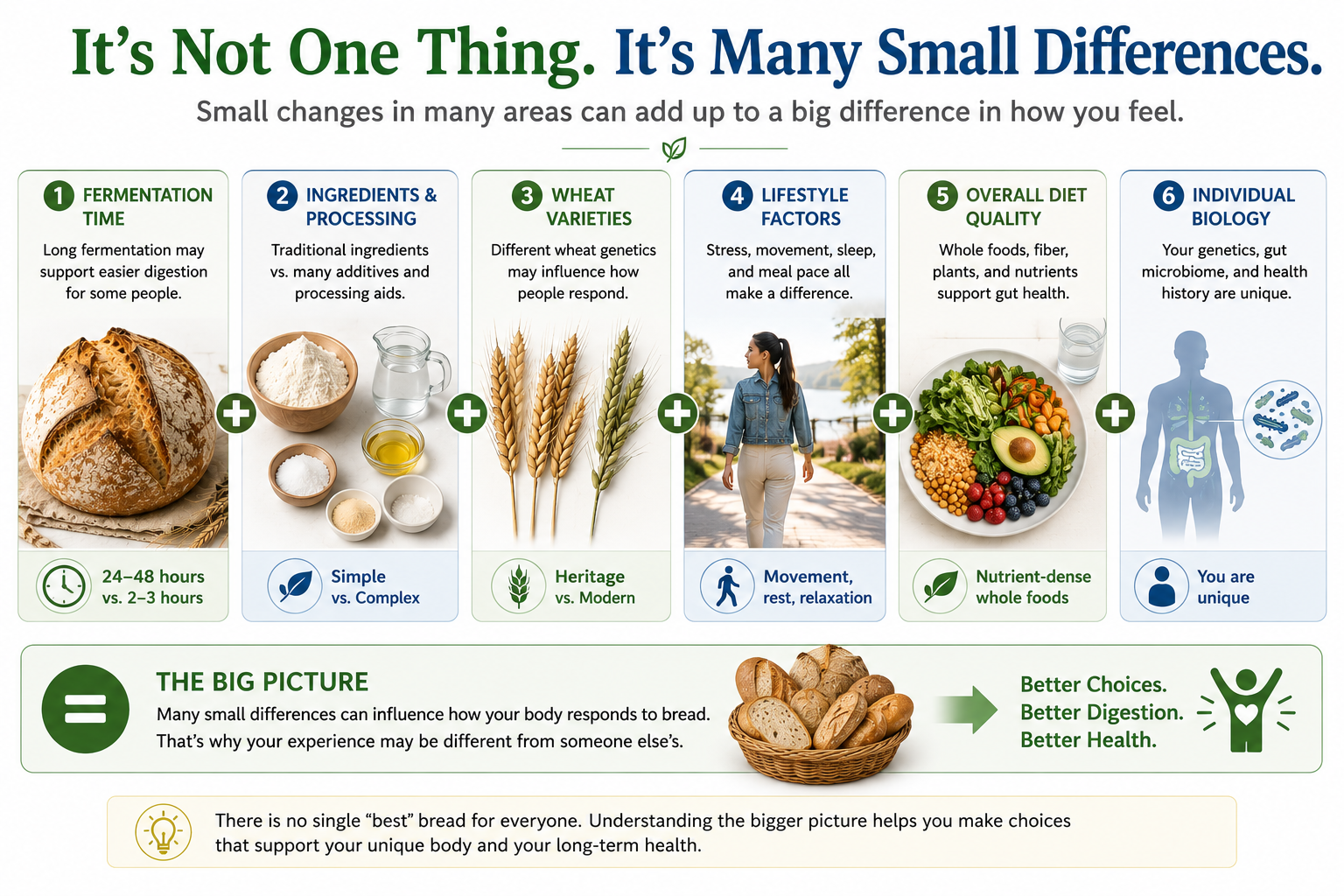
How your body responds to bread is rarely determined by a single factor. Fermentation, ingredients, wheat varieties, overall diet, lifestyle, gut health, and individual biology all work together to influence digestion and tolerance.
One of the biggest mistakes people make is searching for a single villain.
We naturally want one simple answer.
“It’s the gluten.”
“It’s the glyphosate.”
“It’s modern wheat.”
“It’s the additives.”
While each of these factors may play a role, human biology is rarely that straightforward.
Think about baking a loaf of bread. If the finished loaf doesn’t turn out well, would you blame only the flour? Probably not. The quality of the water, the yeast, the fermentation time, the oven temperature, and even the baker’s technique all influence the final result. Health works much the same way.
When someone tells me they can eat bread in Europe without any problems but feel terrible after eating bread in the United States, I don’t immediately assume there is one explanation. Instead, I start asking questions.
Was the bread made with a traditional long fermentation or produced rapidly in a factory? Were there additional preservatives, emulsifiers, or dough conditioners? Was the wheat variety different? How healthy was the person’s gut microbiome? Were they under less stress while traveling? Did they walk more, sleep better, eat smaller portions, or simply enjoy slower meals?
Each of these factors can influence digestion and how the body responds to food. On their own, they may have only a small effect. Together, however, they can create a very different biological environment.
This is one of the reasons functional medicine takes a broader view of health. Rather than asking, “What’s the one thing causing my symptoms?” we ask a different question:
“What combination of factors is creating the environment that allows these symptoms to develop?”
In my experience, that’s where the most meaningful answers are found.
The goal isn’t to prove that European bread is “good” or American bread is “bad.” The goal is to understand why your body may respond differently under different circumstances. When we stop looking for a single culprit and start looking at the whole picture, we often uncover opportunities for healing that would otherwise be missed.
Dr. Scott Insight
One of the biggest mistakes I see is assuming there is one single explanation.
In practice, I suspect many patients are reacting to a combination of factors rather than one ingredient alone.
Food quality.
Processing.
Fermentation.
Gut health.
Microbiome balance.
Lifestyle.
Stress.
All of these influence digestion.
Rather than asking, “Is European bread healthier?” I encourage patients to ask a better question:
“Why does my body respond differently in different environments?”
That question usually leads to much more useful answers.
Practical Takeaways
If you suspect bread contributes to your symptoms:
- Start with a structured gluten elimination trial.
- Pay attention to ingredient quality.
- Compare artisan sourdough with highly processed bread.
- Support gut health before assuming wheat is the only problem.
- Focus on your body’s response rather than internet opinions.
Key Takeaways
✔ European bread is not automatically healthier than American bread.
✔ Traditional sourdough fermentation may improve digestibility for some people.
✔ Ultra-processing may influence how bread affects the body.
✔ Glyphosate remains an area of active research and scientific debate.
✔ Lifestyle differences may explain part of the “European bread effect.”
✔ Personalized nutrition remains more valuable than one-size-fits-all dietary advice.
Could Your Bread Be Affecting Your Health?
If you experience bloating, digestive discomfort, fatigue, brain fog, or other symptoms after eating bread, a functional medicine evaluation may help identify the underlying cause rather than simply eliminating foods through trial and error.
Learn more about our Functional Medicine services:
https://totalhealthcentervb.com/functional-medicine/
References
- National Center for Biotechnology Information (NCBI)
- PubMed – Sourdough Fermentation and Gluten Digestion
- PubMed – Wheat Processing and Digestibility
- EFSA (European Food Safety Authority)
- USDA Wheat Production Resources
- De Angelis M, et al. Sourdough Fermentation of Wheat Flour Reduces Gluten and Improves Digestibility. Applied and Environmental Microbiology.
- Gobbetti M, De Angelis M, Di Cagno R, et al. Sourdough Lactic Acid Bacteria and Their Role in Bread Digestibility and Gluten Degradation. Food Microbiology.
- Biesiekierski JR, et al. No Effects of Gluten in Patients With Self-Reported Non-Celiac Gluten Sensitivity Following Dietary Reduction of FODMAPs. Gastroenterology. (A landmark study showing that, in some individuals, FODMAPs rather than gluten may explain symptoms.)
- Fasano A. Zonulin, Regulation of Tight Junctions, and Autoimmune Disease. Annals of the New York Academy of Sciences.
- European Food Safety Authority (EFSA). Glyphosate Risk Assessment and Regulatory Review.
- United States Department of Agriculture (USDA). Wheat Production and Grain Quality Resources.
- National Center for Biotechnology Information (NCBI). Research database for gluten, wheat processing, sourdough fermentation, and intestinal permeability.
About Dr. Scott
Dr. Scott of Total Health Center in Virginia Beach has been helping patients improve digestive health, food sensitivities, thyroid disorders, autoimmune conditions, and chronic inflammation through functional medicine since 1997. His approach focuses on identifying and addressing underlying causes through advanced testing, personalized nutrition, lifestyle medicine, and evidence-informed clinical care.
Frequently Asked Questions
Why do some people say they can eat bread in Europe but not in America?
Many people report feeling better after eating bread in parts of Europe than they do after eating bread in the United States. While this experience has not been proven to result from a single cause, researchers believe differences in fermentation methods, ingredient quality, food processing, wheat varieties, and overall lifestyle may all play a role.
Is European wheat lower in gluten?
Not necessarily. Europe and North America both grow multiple wheat varieties with varying gluten content. Current evidence suggests that how bread is made—including fermentation time and processing—may have a greater influence on digestibility than where the wheat was grown.
Is sourdough easier to digest than regular bread?
Traditional sourdough undergoes a long fermentation process that may partially break down some gluten proteins and FODMAP carbohydrates. Many people report that authentic sourdough is easier to digest, although it is not considered safe for individuals with celiac disease unless specifically certified gluten-free.
Does glyphosate explain why people react differently to bread?
Glyphosate is an area of ongoing scientific debate. Some researchers have proposed that it may influence gut health or the microbiome, but current evidence does not establish glyphosate as the primary reason people experience gluten-related symptoms. More high-quality research is needed.
Are food additives part of the problem?
Modern commercial bread often contains preservatives, dough conditioners, emulsifiers, added sugars, and other ingredients that are not found in traditional artisan bread. Some researchers believe that the overall degree of food processing may influence digestion and individual tolerance.
Could lifestyle explain why bread seems easier to tolerate in Europe?
Yes. Vacation often brings lower stress levels, more physical activity, slower meals, improved sleep, and fewer ultra-processed foods. These factors can all affect digestion, making it difficult to attribute differences solely to the bread itself.
Should I switch to European bread if American bread bothers me?
Not necessarily. Before importing specialty breads, it is often more helpful to determine why you are reacting. Gluten sensitivity, FODMAP intolerance, food additives, gut health, microbiome balance, or another digestive condition may all contribute to symptoms.
Is ancient wheat healthier than modern wheat?
Ancient wheat varieties differ genetically from many modern high-yield varieties, but this does not automatically make them healthier or gluten-free. Researchers continue studying whether some older wheat varieties may be better tolerated by certain individuals.
What is the best way to determine if bread is causing my symptoms?
A structured elimination and reintroduction trial is often one of the most practical approaches. Working with a qualified healthcare practitioner can help identify whether gluten, FODMAPs, food additives, or another factor may be contributing to your symptoms.
What does functional medicine recommend?
Functional medicine focuses on identifying the underlying reason for food reactions rather than assuming all bread affects everyone the same way. The goal is to understand your unique biology and develop a personalized nutrition plan that supports long-term health.
Next Lesson
Lesson #14
Years of Gluten Damage Require More Than Simply Going Gluten-Free
We’ll explore why removing gluten is often only the first step and how rebuilding the gut, restoring nutrient status, supporting the microbiome, and reducing inflammation are essential parts of long-term recovery.