
What Your Cycle Can Tell You About Your Health
Your menstrual cycle is more than a monthly event. It is the result of communication between your brain, ovaries, thyroid, metabolism, stress-response systems, nutrition, and overall health. Functional medicine and menstrual cycle health are closely connected because changes in your cycle can provide valuable clues about what may be happening elsewhere in your body.
When that communication is working well, the menstrual cycle tends to follow a relatively predictable rhythm. When something changes, your cycle may change with it.
Periods may become heavier or lighter. Cycles may become longer, shorter, painful, unpredictable, or disappear altogether.
These changes should not automatically be dismissed as simply a “hormone imbalance.” They are information.
A functional medicine approach asks a broader question:
What might your menstrual cycle be telling us about how your body is functioning?
At Total Health Center, this is how we approach menstrual and hormone health. Rather than looking at reproductive hormones in isolation, we consider the physiological environment in which those hormones are being produced, regulated, metabolized, and used.
How a Healthy Menstrual Cycle Works
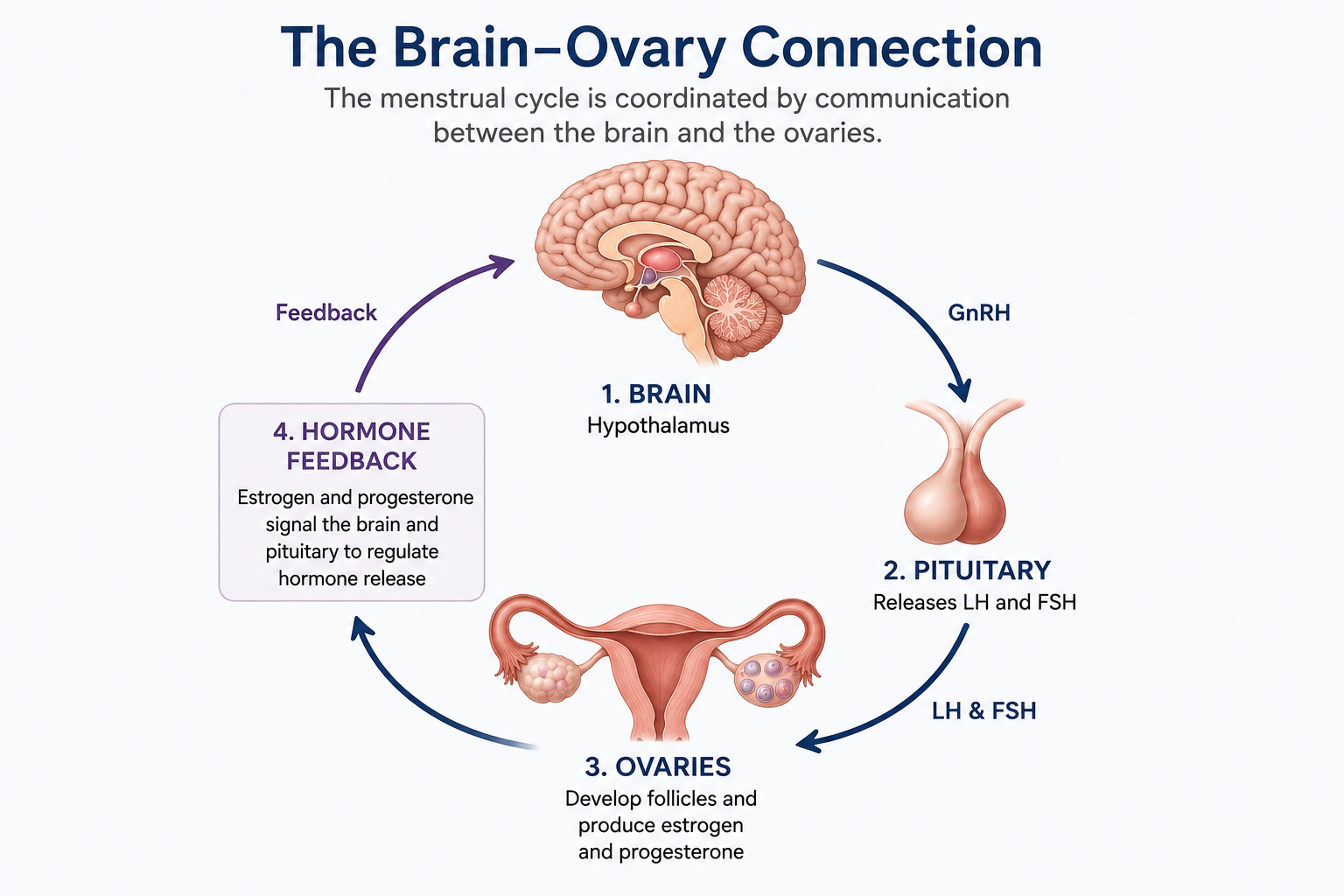
The menstrual cycle is regulated through communication between the brain, pituitary gland, and ovaries, with reproductive hormones providing feedback that helps coordinate the cycle.
The menstrual cycle is controlled by an ongoing conversation between the brain and the ovaries.
The hypothalamus in the brain communicates with the pituitary gland, which releases hormones that signal the ovaries. The ovaries respond by developing follicles, producing estrogen and progesterone, and—during an ovulatory cycle—releasing an egg.
These changing hormone signals influence the uterine lining and ultimately determine when menstruation occurs.
But this system does not operate independently from the rest of the body.
The brain is continually receiving information about your internal environment:
- Is adequate energy available?
- Are nutrients available?
- Is the body under significant physical or psychological stress?
- Is thyroid function appropriate?
- Is blood sugar reasonably stable?
- Is sleep adequate?
- Is there illness or another physiological stressor?
This helps explain why menstrual function can change when other aspects of health change.
Dr. Scott’s Insight
The reproductive system is part of the whole body. When the menstrual cycle changes, I don’t want to look only at estrogen and progesterone. I want to understand what else may have changed in the woman’s physiology.
What Can Changes in Your Menstrual Cycle Tell Us?
There isn’t one menstrual pattern that is perfect for every woman, and cycles can naturally vary somewhat from month to month.
But meaningful or persistent changes deserve attention.
These can include:
- Cycles becoming consistently longer or shorter
- Irregular or unpredictable periods
- Very heavy bleeding
- Periods becoming unusually light
- Missing periods
- Significant menstrual pain
- Spotting or bleeding between periods
- New or worsening premenstrual symptoms
The pattern itself does not necessarily tell us the cause.
That’s an important distinction.
For example, an irregular cycle could be associated with PCOS, thyroid dysfunction, changes in energy intake, significant stress, excessive exercise, pregnancy, perimenopause, certain medications, or other health conditions.
The goal should not simply be to label every change a “hormone imbalance.”
The goal is to understand why the pattern changed.
The Brain–Ovary Connection: Why Stress and Energy Matter
One of the most interesting aspects of reproductive physiology is that the brain helps regulate reproductive function according to the body’s broader physiological environment.
From an adaptive perspective, this makes sense.
Reproduction requires energy and resources. When the brain receives signals suggesting that energy availability is inadequate or that the body is under substantial physiological stress, reproductive signaling can change.
This is one reason menstrual cycles may be affected by:
- Chronic psychological stress
- Significant calorie restriction
- Rapid weight loss
- Very low body fat
- Excessive exercise
- Poor sleep
- Illness
- A combination of several stressors
This does not mean that every irregular menstrual cycle is caused by “stress.”
It means that the reproductive system is responsive to the environment in which the body is functioning.
That distinction is central to functional medicine.
Instead of treating each system as though it exists independently, we look at the relationships between them.
Insulin Resistance, PCOS, and Menstrual Health

Physical activity and maintaining muscle can support insulin sensitivity and metabolic health, which may also influence reproductive and menstrual function.
Metabolic health can have a major influence on reproductive hormone signaling.
One of the clearest examples is polycystic ovary syndrome (PCOS).
PCOS is a complex condition, and not every woman with PCOS has the same metabolic pattern. However, insulin resistance and elevated insulin levels are important contributors for many women.
Insulin does more than regulate blood sugar.
It also interacts with ovarian hormone production and can influence androgen levels, ovulation, body composition, and reproductive function.
This helps explain why some women may experience a combination of:
- Irregular or absent periods
- Difficulty ovulating
- Acne
- Increased facial or body hair
- Weight gain or difficulty losing weight
- Blood sugar problems
In these situations, focusing exclusively on reproductive hormones may miss an important part of the picture.
Improving metabolic health may become part of improving the physiological environment supporting normal reproductive function.
Learn more about our approach to Functional Medicine and Metabolic Health.
Thyroid Function and the Menstrual Cycle
Thyroid hormones influence metabolism throughout the body, including systems involved in reproductive function.
Both underactive and overactive thyroid conditions can be associated with changes in menstruation.
Depending on the individual, thyroid dysfunction may contribute to:
- Irregular cycles
- Changes in menstrual flow
- Changes in cycle length
- Problems with ovulation
- Fertility concerns
- Fatigue
- Weight changes
- Changes in body temperature
- Hair or skin changes
This is another reason we should be careful about assuming that menstrual symptoms are simply caused by estrogen or progesterone.
Sometimes the reproductive symptoms are part of a larger thyroid picture.
Total Health Center has an extensive thyroid education library. A useful starting point is Thyroid Problems and Symptoms.
Nutrition, Energy Availability, and Hormone Health
The body requires adequate energy, protein, essential fats, vitamins, minerals, and other nutrients to maintain normal physiology.
Reproductive function is no exception.
Extreme dieting, chronic calorie restriction, highly restrictive eating patterns, or inadequate nutrient intake can sometimes contribute to menstrual changes.
Rather than asking only:
“Which supplement balances hormones?”
I think a better question is:
“Does the body have the nutritional resources it needs to function normally?”
Depending on the individual, we may look at overall food intake, protein intake, dietary quality, iron status, vitamin D, B vitamins, magnesium, essential fatty acids, and other nutritional considerations.
This does not mean that taking a handful of supplements automatically corrects menstrual problems.
Nutrition is part of the physiological foundation. The objective is to identify what the individual woman actually needs.
Gut and Liver Health: Where Do They Fit?
Hormones do not simply appear in the bloodstream and remain there indefinitely.
They are produced, transported, transformed, metabolized, and eventually eliminated.
The liver plays an important role in hormone metabolism, while the digestive system and intestinal microbiome can influence how certain hormone metabolites are processed and eliminated.
This creates a legitimate connection between digestive health and hormone physiology.
However, that does not mean every menstrual problem is caused by the gut or that a generic “detox” program will balance everyone’s hormones.
A functional medicine approach should be more individualized than that.
If a woman has significant digestive symptoms, altered bowel function, nutritional problems, or other indications that digestive health may be contributing to her broader health picture, those issues deserve consideration.
Learn more about Functional Medicine and Digestive Health.
Environmental Exposures and Hormone Health
 Our physiology developed in an environment very different from the one in which we live today.
Modern life exposes us to numerous synthetic chemicals, some of which can interact with endocrine signaling.
These are often referred to as endocrine-disrupting chemicals.
Exposure can occur through food packaging, plastics, cosmetics, household products, occupational environments, and other sources.
It would be unrealistic to suggest that we can eliminate every exposure—or that environmental chemicals explain every hormone problem.
But reducing unnecessary exposure where practical can be one component of a broader health strategy.
The objective isn’t to become afraid of the environment.
It is to recognize that our environment is one of the inputs our physiology must respond to.
How Functional Medicine Evaluates Menstrual Problems
Functional medicine begins with the individual rather than automatically beginning with a laboratory panel.
The first step is understanding the pattern.
When did the menstrual problem begin?
What were cycles like previously?
Did anything change around the same time?
What other symptoms are present?
We may consider:
- Menstrual history
- Pregnancy possibility
- Age and life stage
- Thyroid symptoms
- Blood sugar and metabolic health
- Stress
- Sleep
- Exercise
- Nutrition and energy intake
- Weight or body-composition changes
- Digestive health
- Medications
- Existing medical conditions
- Previous laboratory results
Testing can then be used when it helps answer a meaningful clinical question.
Depending on the circumstances, appropriate evaluation may include thyroid testing, blood counts and iron status, metabolic markers, reproductive hormones, or other testing based on the woman’s history and symptoms.
More testing is not automatically better testing.
The purpose is to gather information that helps us understand the physiology and make better decisions.
Learn more about Understanding Functional Medicine Testing.
Supporting Normal Menstrual Physiology
Once we understand the likely contributors, the objective becomes supporting the systems that can actually be improved.
That may involve:
- Improving nutritional adequacy
- Supporting healthy blood sugar regulation
- Addressing insulin resistance
- Improving sleep
- Building appropriate physical activity
- Avoiding excessive exercise or inadequate energy intake
- Addressing significant stress
- Correcting identified nutrient deficiencies
- Evaluating thyroid function when appropriate
- Addressing digestive problems when they are relevant
- Reducing unnecessary endocrine-disrupting exposures
- Coordinating appropriate medical care when needed
There isn’t one “hormone-balancing diet,” supplement, or protocol that makes sense for every woman.
The intervention should follow the physiology.
Dr. Scott’s Insight
My goal isn’t to force every woman into the same laboratory range or give everyone the same hormone protocol. The goal is to understand what her body is doing, identify factors that may be interfering with normal function, and support the physiology wherever we reasonably can.
When Menstrual Changes Need Medical Evaluation
A functional medicine perspective should never mean ignoring symptoms that warrant conventional medical evaluation.
Seek appropriate medical care for concerns such as:
- Extremely heavy bleeding
- Bleeding that causes weakness, dizziness, or symptoms of anemia
- New or severe pelvic pain
- Possible pregnancy with bleeding or significant pain
- Persistent absence of menstruation when pregnancy is not the explanation
- Bleeding between periods that persists or is unexplained
- Bleeding after menopause
- A significant new change in your usual menstrual pattern
Depending on the situation, evaluation by a primary-care physician, gynecologist, or another appropriate specialist may be necessary.
Functional medicine and appropriate medical evaluation are not competing ideas.
The objective is to understand the problem and choose the right tools for the individual woman.
From the Menstrual Years to Perimenopause and Menopause
The reproductive system continues to change throughout a woman’s life.
As women approach perimenopause, ovulation can become less predictable and estrogen and progesterone patterns begin changing. Cycles may become shorter, longer, heavier, lighter, or increasingly irregular before menstruation eventually stops.
Understanding how reproductive physiology works before menopause can make this transition far less mysterious.
Menopause itself is not evidence that the female body has failed. It is another physiological transition requiring adaptation.
Read more about our Functional Medicine approach to Menopause.
A Functional Medicine Perspective on the Menstrual Cycle
Your menstrual cycle should not be viewed in isolation from the rest of your health.
It is influenced by an interconnected physiological system involving the brain, ovaries, thyroid, metabolism, nutrition, stress response, sleep, activity, and other aspects of health.
When menstrual patterns change, the answer is not always to suppress the symptom or simply label it a hormone imbalance.
Sometimes the most valuable first step is asking:
What is the body responding to?
That question opens the door to understanding the individual rather than simply treating the menstrual cycle as an isolated event.
At Total Health Center, our functional medicine approach is designed to help patients better understand their health, identify factors that may be interfering with normal function, and develop an individualized strategy for supporting healthier physiology.
Continue Learning
Functional Medicine & Hormone Health
Explore the broader relationship between hormones, metabolism, thyroid function, stress, and whole-body health.
Functional Medicine for Menopause
Learn how physiology changes through perimenopause and menopause and how we approach this transition.
Functional Medicine & Metabolic Health
Learn how insulin resistance, blood sugar, body composition, and metabolism interact with overall health.
Thyroid Problems & Symptoms
Understand how thyroid dysfunction can affect energy, metabolism, temperature regulation, reproductive health, and other systems.
Understanding Functional Medicine Testing
Learn why testing should be selected to answer meaningful clinical questions rather than simply ordering the largest possible panel.
About Dr. Scott
Dr. Mark Scott is the founder and clinic director of Total Health Center in Virginia Beach, Virginia. Since 1997, he has worked with patients experiencing chronic and complex health concerns using a functional medicine approach.
His clinical focus includes hormone health, thyroid disorders, metabolic dysfunction, digestive problems, autoimmune conditions, and chronic fatigue.
Dr. Scott’s approach emphasizes patient education, understanding physiology, identifying factors that may interfere with normal function, and helping patients make informed decisions about their health.
Frequently Asked Questions
What can an irregular menstrual cycle indicate?
Irregular cycles can occur for many reasons, including pregnancy, PCOS, thyroid dysfunction, significant stress, changes in energy intake or exercise, weight changes, medications, perimenopause, and other medical conditions. The pattern alone does not establish the cause, which is why the woman’s broader health history matters.
Can stress really affect the menstrual cycle?
Yes. The brain regulates reproductive signaling, and significant physical or psychological stress can influence the hypothalamic-pituitary-ovarian system. Stress is not the cause of every menstrual problem, but it can be an important contributor in some women.
Can thyroid problems affect menstruation?
Yes. Thyroid dysfunction can be associated with changes in cycle regularity, menstrual flow, ovulation, and fertility. Thyroid symptoms can also overlap with symptoms commonly attributed to hormone problems.
What does insulin resistance have to do with menstrual cycles?
Insulin influences more than blood sugar. In some women, particularly those with PCOS, insulin resistance and elevated insulin can affect ovarian hormone production, androgen levels, and ovulation.
Can nutrition affect the menstrual cycle?
Yes. Inadequate energy intake, significant calorie restriction, nutritional deficiencies, and major changes in body weight can affect reproductive physiology in some women. Nutrition should be evaluated in the context of the individual’s overall health rather than assuming one diet or supplement is appropriate for everyone.
Does functional medicine use hormone testing for menstrual problems?
Sometimes. Hormone testing may be useful when it answers a specific clinical question, but testing should be guided by symptoms, menstrual history, age, medications, existing conditions, and other relevant information. More testing is not automatically better.
Does every irregular period mean I have a hormone imbalance?
No. Menstrual changes have many possible causes. Reproductive hormones are part of the picture, but thyroid function, metabolic health, pregnancy, energy availability, stress, medications, life stage, and other health conditions may also need to be considered.
How does functional medicine approach menstrual problems?
Functional medicine looks at menstrual symptoms within the context of the whole person. The goal is to understand the pattern, identify potential contributors, use testing when appropriate, and support the aspects of physiology that can reasonably be improved.
Reclaim Your Natural Cycle with Functional Medicine
Your menstrual cycle is a powerful indicator of your overall health. With Functional Medicine, you can restore it naturally by nourishing your body, balancing hormones, and addressing the root causes of menstrual irregularities. Instead of relying on temporary fixes, this holistic approach focuses on long-term health and well-being.
If you’re ready to take control of your menstrual health and restore your natural rhythm, consider working with a Functional Medicine practitioner to develop a personalized wellness plan. Your body is resilient, capable of healing, and designed to thrive. Embrace Functional Medicine to reclaim your menstrual health, restore balance, and step into a healthier, more vibrant version of yourself.
Contact Us Today to Restore Your Menstrual Health
Total Health is here to help you regain balance and restore your menstrual cycle naturally. Contact us today to schedule a FREE consultation and start your journey to better health with Functional Medicine.
Awards

Congratulations to Mark Scott’s Practice on winning the 2015 Patients’ Choice Awards for Chiropractor in Virginia Beach, VA
Verified by
Opencare.com
Awards
Congratulations to Mark Scott’s Practice on winning the 2015 Patients’ Choice Awards for Chiropractor in Virginia Beach, VA
Verified by
Opencare.com