
Looking Beyond Routine Lab Work
One of the most common questions we hear from new patients is, “What tests do you perform?”
The answer surprises many people.
Functional medicine is not defined by advanced laboratory testing. It is defined by asking better questions.
While specialized testing can provide valuable information in the right situation, it is only one part of a comprehensive evaluation. Your health history, symptoms, previous laboratory results, lifestyle, nutrition, medications, stress, and health goals often provide just as much insight as any laboratory report.
Our philosophy is simple: the right test for the right patient at the right time.
Rather than ordering extensive testing for everyone, we begin by understanding your unique health story. In many cases, previous laboratory work already contains valuable information that deserves a closer look. When additional testing is appropriate, it is selected because it helps answer specific clinical questions and guides a more personalized approach to your care.
The goal isn’t simply to collect more data. The goal is to gather meaningful information that helps us better understand your health and develop recommendations that are individualized, practical, and evidence-informed.
Internal Links
What Makes Functional Medicine Different
What to Expect During Your First Functional Medicine Visit
Why Testing Is Only Part of the Picture
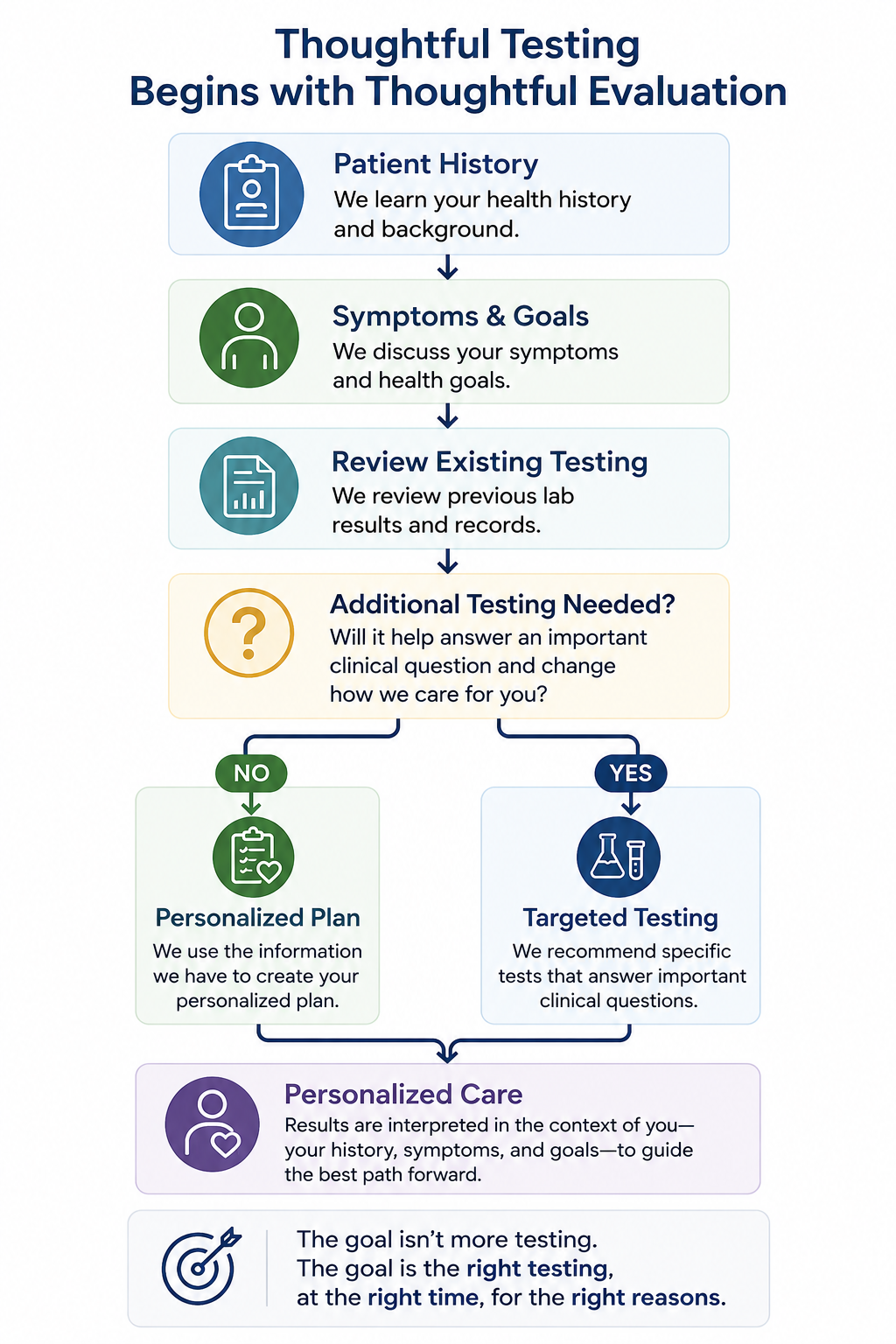
Functional medicine begins with understanding the patient. Additional testing is recommended only when it helps answer important clinical questions and supports a personalized approach to care.
Laboratory testing can be a valuable tool, but it should never replace a thoughtful clinical evaluation. At Total Health Center, we believe that good testing begins with good listening.
Before recommending additional laboratory work, we take time to understand your health history, current symptoms, previous diagnoses, lifestyle, nutrition, medications, and health goals. This conversation often provides important clues that help determine whether additional testing is appropriate and, if so, which tests are most likely to provide meaningful information.
Many patients are surprised to learn that we often begin by reviewing laboratory tests they have already completed. Previous blood work, imaging studies, and medical records may contain valuable information that deserves a closer look before ordering anything new.
When additional testing is recommended, it is because we are trying to answer a specific clinical question—not simply collect more data. The goal is to gather information that helps guide personalized recommendations and supports informed healthcare decisions.
No laboratory test can diagnose every health concern or replace a comprehensive medical evaluation. Instead, testing becomes one piece of a much larger picture that includes your symptoms, medical history, physical findings, and overall health goals.
Internal Links
What to Expect During Your First Functional Medicine Visit
Functional Medicine & Digestive Health
Dr. Scott Insight
One of the biggest misconceptions about functional medicine is that everyone needs extensive testing. In reality, the best testing strategy is the one that answers the most important clinical questions while avoiding unnecessary expense. Sometimes your previous laboratory work already tells us much more than you realize.
What Types of Testing May Be Used in Functional Medicine?
Every patient is different, which means every evaluation is different. Some people need little or no additional testing, while others may benefit from a more detailed assessment based on their symptoms, health history, and previous laboratory findings.
Depending on your individual situation, we may review or recommend testing in areas such as:
Standard Blood Work
Routine laboratory testing often provides valuable information about blood sugar, cholesterol, liver and kidney function, inflammation, nutrient status, and other important markers. Before ordering additional tests, we carefully review any blood work you have already completed.
Thyroid Evaluation
Thyroid dysfunction can affect energy, metabolism, digestion, mood, weight, and many other aspects of health. In some cases, a more comprehensive thyroid evaluation may provide additional insight beyond routine screening.
Digestive Health Testing
For patients with persistent digestive symptoms, additional evaluation may sometimes help identify factors that could be contributing to gastrointestinal complaints. The decision to pursue digestive testing depends on your symptoms, medical history, and previous evaluations.
Functional Medicine & Digestive Health
Hormone Evaluation
When appropriate, hormone testing may be considered to better understand concerns related to metabolism, energy, mood, or other symptoms. The specific type of testing depends on the individual’s health history and clinical presentation.
Nutritional Assessment
Vitamin, mineral, and other nutritional evaluations may be appropriate when deficiencies or imbalances are suspected based on your history, symptoms, or previous laboratory findings.
Specialized Functional Testing
In selected situations, specialized laboratory testing may provide additional information that helps answer specific clinical questions. These tests are not recommended for everyone and are only considered when they are likely to contribute meaningfully to your personalized care plan.
The goal is not to perform the greatest number of tests. The goal is to perform the right tests—when they are appropriate—and use that information to better understand your health.
How Testing Helps Build a Personalized Care Plan
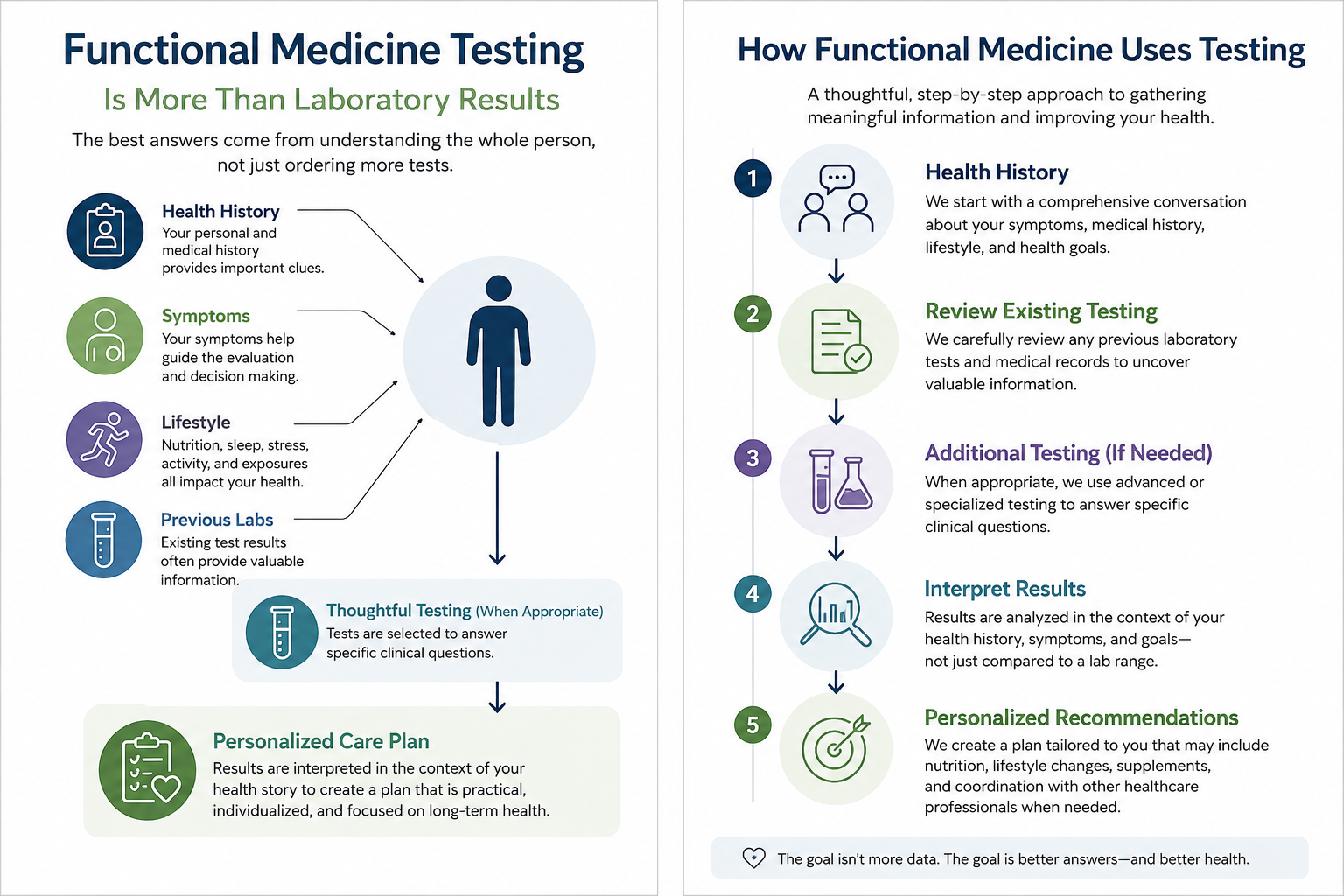
Functional medicine testing is designed to answer important clinical questions and help guide individualized care—not simply generate more laboratory data.
The purpose of testing is not simply to generate more information—it’s to provide information that can be used to make better decisions.
Once your health history, symptoms, previous records, and any appropriate laboratory results have been reviewed, we look for patterns that may help explain your health concerns. Those findings are considered alongside your personal goals, lifestyle, nutrition, and current medical care to develop recommendations tailored to your individual situation.
For one patient, the next step may be simple dietary and lifestyle changes. For another, it may involve addressing nutritional deficiencies, improving digestive health, supporting thyroid function, or working more closely with other healthcare providers. Every plan is individualized because every patient is different.
Functional medicine is not about treating laboratory numbers. It is about using the information available to better understand the whole person and develop practical recommendations that support long-term health.
Testing provides answers—but those answers are most valuable when they are interpreted within the context of your complete health story.
Functional Medicine
https://totalhealthcentervb.com/functional-medicine/
What Makes Functional Medicine Different
Dr. Scott Insight
A laboratory result by itself rarely tells the whole story. The real value comes from understanding what those findings mean in the context of your symptoms, health history, and personal goals. That’s why functional medicine begins with the patient—not the test.
Is Functional Medicine Testing Right for You?
Not everyone needs advanced laboratory testing. In many cases, a careful review of your health history, symptoms, lifestyle, and previous laboratory work provides valuable information before any additional testing is considered.
When testing is appropriate, it should answer important clinical questions and help guide a more personalized approach to your care. The goal is not to perform the greatest number of tests, but to gather meaningful information that supports informed healthcare decisions.
If you’ve been struggling with chronic health concerns, have been told your tests are “normal” despite continuing symptoms, or simply want a more comprehensive evaluation of your health, functional medicine may offer a different perspective.
The first step is a conversation. Together, we’ll review your health history, discuss your concerns, evaluate any previous testing, and determine whether additional laboratory evaluation is appropriate for your individual situation.
Ready to Learn More?
If you’re interested in a personalized functional medicine evaluation, we’d be happy to help.
Schedule Your Functional Medicine Consultation
📞 757-363-8571
or request an appointment through our website.
Continue Learning
What Makes Functional Medicine Different
What to Expect During Your First Functional Medicine Visit
Functional Medicine & Digestive Health
Functional Medicine & Autoimmune Disease
About Dr. Scott
About Dr. Scott
Dr. Mark Scott has been helping patients improve their health through functional medicine and chiropractic care since 1997. His approach focuses on identifying the underlying factors that may be contributing to chronic health concerns rather than simply managing symptoms.
Every patient receives a personalized evaluation that considers health history, previous laboratory testing, nutrition, lifestyle, stress, and other factors that influence overall wellness. When appropriate, advanced laboratory testing is used to answer specific clinical questions and help guide individualized recommendations.
Whether you are seeking answers for digestive concerns, thyroid disorders, autoimmune conditions, fatigue, hormone imbalance, or other chronic health challenges, Dr. Scott’s goal is to help you better understand your health and develop a practical plan that supports long-term wellness alongside appropriate medical care.
References
- Institute for Functional Medicine (IFM). What Is Functional Medicine?
- National Institutes of Health (NIH). https://www.nih.gov
- National Center for Complementary and Integrative Health (NCCIH). https://www.nccih.nih.gov
- National Institute of Diabetes and Digestive and Kidney Diseases (NIDDK). https://www.niddk.nih.gov
- Cleveland Clinic. https://my.clevelandclinic.org
- Harvard Health Publishing. https://www.health.harvard.edu
Frequently Asked Questions
1. What is functional medicine testing?
Functional medicine testing is an individualized approach to evaluating health. It may include reviewing previous laboratory work and, when appropriate, recommending additional testing to help answer specific clinical questions and guide a personalized care plan.
2. Does everyone need advanced functional medicine testing?
No. Many patients benefit from a thorough review of their health history, symptoms, lifestyle, and existing laboratory results before additional testing is considered. Testing is recommended only when it is likely to provide meaningful information.
3. What types of tests might be recommended?
Depending on your health concerns, testing may include standard blood work, thyroid evaluation, nutritional assessments, digestive health testing, hormone evaluation, or other specialized laboratory studies. Every recommendation is based on your individual needs.
4. Can you use laboratory tests I have already completed?
Yes. Previous laboratory work often provides valuable information. We frequently begin by reviewing existing test results before deciding whether additional testing is necessary.
5. Is functional medicine testing covered by insurance?
Coverage depends on your insurance plan and the specific tests being ordered. Routine laboratory tests are often covered, while some specialized functional medicine tests may not be. We discuss testing recommendations and potential costs with you before proceeding.
6. Does abnormal testing always mean I have a disease?
Not necessarily. Laboratory results are interpreted alongside your symptoms, medical history, lifestyle, and physical findings. Testing is one piece of the overall clinical picture and should not be viewed in isolation.
7. How do test results influence my treatment plan?
Test results help identify patterns and provide additional information that may guide nutrition, lifestyle recommendations, targeted supplementation, referrals, or other personalized treatment strategies. Recommendations are always based on your complete health picture rather than laboratory numbers alone.
8. How do I know if functional medicine testing is right for me?
If you have ongoing symptoms, chronic health concerns, or have been told your laboratory tests are “normal” despite not feeling well, a functional medicine evaluation may help determine whether additional testing is appropriate and what information could be most useful.