

Reverse T3: Why Normal Thyroid Tests Don’t Always Mean Your Thyroid Is Working
By Dr. Mark Scott | Total Health Center
When the Lab Says You’re Fine, But Your Body Disagrees
You finally decide it’s time to have your thyroid checked.
For months you’ve been dragging yourself through the day. You’re exhausted even after a full night’s sleep. You’ve gained weight despite eating well. Your hands are always cold. You struggle to concentrate, and by mid-afternoon your brain feels like it’s running through mud.
Your doctor orders a thyroid panel.
A few days later the phone rings.
“Good news,” they say. “Your thyroid tests are normal.”
For many people, that should be reassuring.
Instead, it’s frustrating.
Because your body is telling a completely different story.
If you’ve ever been told your thyroid is “normal” while you continue to battle fatigue, brain fog, weight gain, dry skin, constipation, or low body temperature, you’re not alone. Every week I meet patients who have been searching for answers after being told that everything looks fine on paper.
Sometimes the missing piece is a laboratory marker called Reverse T3.
Reverse T3 has become one of the most talked-about thyroid tests in functional medicine. Unfortunately, it’s also one of the most misunderstood. Some websites describe Reverse T3 as the villain responsible for every thyroid symptom. Others dismiss it as meaningless and never test it at all.
The truth lies somewhere in between.
Reverse T3 is not the enemy.
It’s a message.
Your body may be trying to tell you that something deeper is happening beneath the surface. Understanding that message can completely change how you think about thyroid health.
The Body Is Smarter Than We Give It Credit For
One of the biggest lessons I’ve learned after years of practicing functional medicine is that the body is almost never working against you.
More often, it’s working for you.
Symptoms that seem like problems are often protective adaptations. Fever helps fight infection. Pain tells us something needs attention. Inflammation, although harmful when it becomes chronic, is an essential part of the body’s normal healing response after an injury.
Reverse T3 belongs in that same category.
It’s not a mistake.
It’s not a defect.
It’s part of an intelligent survival strategy.
To understand why, let’s first look at how thyroid hormone normally works.
The Accelerator and the Brake
Think of your metabolism like driving a car.
Your active thyroid hormone, T3, is the accelerator.
When T3 enters your cells, it signals them to produce energy. Your metabolism increases. Your body temperature stays warm. Your brain thinks clearly. Your muscles recover efficiently. Nearly every cell in your body works a little harder to keep you functioning at your best.
Like every well-designed vehicle, however, your body also has a braking system.
That’s where Reverse T3 comes in.
Reverse T3 is made from the same hormone, T4, but instead of stimulating metabolism, it slows the metabolic signal. It can attach to many of the same cellular receptors without activating them, reducing the effect of active thyroid hormone.
Imagine placing a key into a lock without turning it.
The key fits.
The door never opens.
That’s a simple way to understand Reverse T3.
Its job isn’t to make you sick.
Its job is to slow things down when slowing down may improve your chances of survival.
At first, that sounds backwards. Why would your body intentionally reduce energy production when you’re already exhausted?
The answer makes much more sense when you think about human evolution.
For nearly all of human history, food shortages, infections, injuries, and harsh environmental conditions were common. During those times, conserving energy could mean the difference between life and death. If food was scarce, burning fewer calories increased your chances of surviving until food became available again. If you were fighting a serious infection or recovering from an injury, slowing metabolism allowed your body to redirect energy toward healing instead of growth and performance.
In other words, producing more Reverse T3 wasn’t a flaw.
It was a survival advantage.
The problem is that our bodies still rely on this ancient survival program, even though the threats we face today have changed. Instead of famine, we experience chronic dieting. Instead of escaping predators, we deal with nonstop deadlines, financial pressures, poor sleep, and chronic psychological stress. Instead of recovering from a short illness, many people live for years with inflammation, insulin resistance, gut dysfunction, or autoimmune disease.
Your brain often interprets these modern stressors much the same way it interpreted starvation thousands of years ago.
One of the ways it responds is by applying the metabolic brakes.
Reverse T3 isn’t trying to harm you.
It’s trying to protect you.
The real question isn’t whether Reverse T3 is high.
The more important question is:
Why does your body believe it needs to slow down?
Understanding Thyroid Hormone Conversion

Figure 1. The body continually evaluates signals such as stress, inflammation, illness, nutrition, and sleep quality when deciding how thyroid hormone is used. Under healthy conditions, more T4 is converted into active T3. During periods of chronic stress or illness, the body may produce more Reverse T3 as a protective mechanism to conserve energy.
To answer that question, it helps to understand how thyroid hormones actually work.
Most people assume the thyroid gland produces the hormone that directly controls metabolism. Surprisingly, that’s not quite true.
Your thyroid gland primarily produces a hormone called T4 (thyroxine). Think of T4 as the raw material. It circulates through your bloodstream waiting to be converted into the hormone your cells actually use.
That active hormone is T3 (triiodothyronine).
The conversion from T4 to T3 takes place throughout the body, particularly in the liver, intestines, kidneys, muscles, and many other tissues. This remarkable system allows your body to fine-tune metabolism based on your changing needs. Under healthy conditions, much of the available T4 is converted into active T3, providing your cells with the energy they need to produce heat, repair tissues, support brain function, maintain muscle strength, and power thousands of metabolic processes every second of the day.
But your body has another option.
Instead of converting T4 into active T3, it can convert some of it into Reverse T3.
This isn’t a mistake—it’s a choice.
Imagine you’re managing the budget for a large company. When business is thriving, you invest in new equipment, hire employees, and expand operations. When times become uncertain, you delay major projects, reduce spending, and conserve resources until conditions improve.
Your metabolism works in much the same way.
When your brain senses that resources are plentiful and the environment is stable, it encourages normal thyroid hormone activity to support growth, repair, reproduction, and energy production. When it senses prolonged stress, illness, inadequate nutrition, or chronic inflammation, it may decide that conserving energy is the wiser strategy.
One way it accomplishes that is by directing more T4 toward Reverse T3 instead of active T3.
This isn’t because your body wants you to feel tired. From a survival standpoint, slowing metabolism may be the safest decision. What feels frustrating to us today was once a remarkable biological adaptation that helped our ancestors survive periods of hardship.
One of the biggest misconceptions about thyroid disorders is the belief that every thyroid symptom begins inside the thyroid gland. In reality, healthy thyroid function depends on much more than the thyroid itself. The liver helps convert T4 into active T3. The digestive tract influences nutrient absorption and immune function. The immune system can attack thyroid tissue in autoimmune conditions such as Hashimoto’s thyroiditis. Minerals such as selenium, zinc, iron, iodine, and magnesium all contribute to normal thyroid hormone production and conversion.
This is why functional medicine views the thyroid as part of a much larger network rather than an isolated organ. If one part of that network is struggling, the thyroid often reflects it. Reverse T3 becomes one more clue that helps us understand the bigger picture.
Instead of asking, “How do I get rid of Reverse T3?” a better question is:
What conditions convinced my body that slowing down was necessary?
Why Your Body May Be Making More Reverse T3
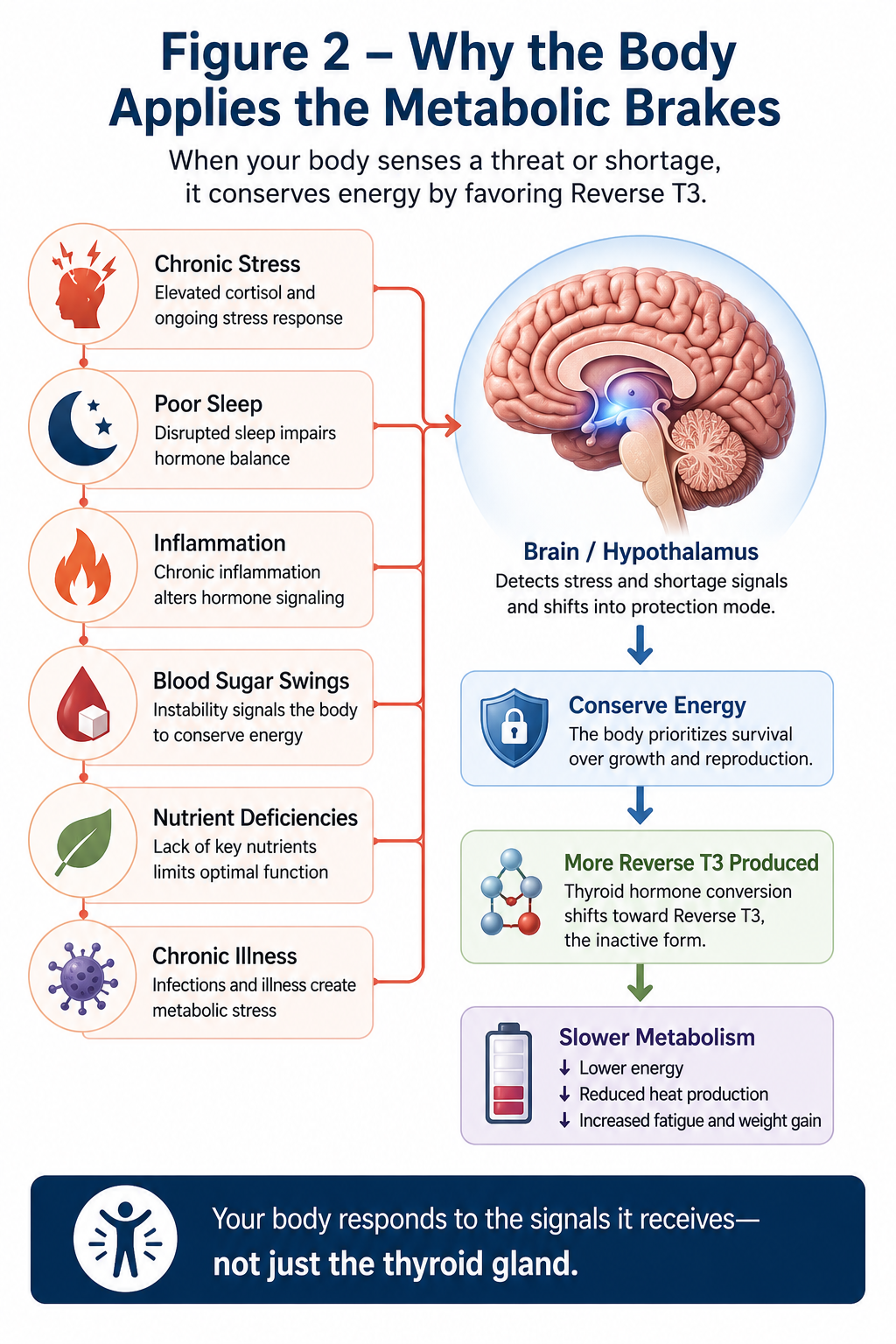
Figure 2. The brain constantly monitors signals from the body. When it detects prolonged stress, inflammation, illness, or inadequate resources, it may favor the production of Reverse T3 as part of a protective energy-conservation response.
If Reverse T3 is part of a survival response, the next question becomes obvious.
What is your body trying to survive?
This is where many conversations about thyroid health take a wrong turn. It’s tempting to focus on the laboratory value itself—to ask how we can lower Reverse T3 or increase T3. But that approach is a little like noticing the “Check Engine” light on your dashboard and disconnecting the bulb instead of looking under the hood.
The laboratory result isn’t the problem.
It’s information.
It’s your body’s way of communicating that something deeper may be affecting your metabolism.
One of the most common reasons I see elevated Reverse T3 is chronic stress. This doesn’t necessarily mean dramatic, life-changing events. More often, it’s the slow accumulation of everyday stress that never fully goes away. Long work hours, financial pressure, poor sleep, chronic pain, caregiving responsibilities, and constant deadlines all place demands on the body. Over time, those demands begin influencing the hormones that regulate energy production.
Your brain doesn’t distinguish particularly well between physical stress and emotional stress. Both activate many of the same hormonal pathways. As stress hormones remain elevated, your body begins making decisions designed to conserve resources. One of those decisions may be shifting more thyroid hormone toward Reverse T3.
Poor sleep can produce a remarkably similar effect. During deep sleep your body performs much of its repair work. Hormones are balanced, tissues recover, inflammation is regulated, and your brain resets for the next day. When sleep becomes fragmented night after night, your body begins operating as though it never has enough time to fully recover. I’ve had many patients who were convinced their thyroid was failing when, in reality, years of inadequate sleep had placed their metabolism into a more conservative state.
Inflammation is another powerful signal. Whether it comes from an autoimmune condition, chronic infections, poor gut health, blood sugar imbalances, excess body fat, or a highly processed diet, inflammation tells your brain that resources need to be redirected toward defense and repair. Once again, slowing metabolism can become part of the strategy.
This is one reason functional medicine rarely views the thyroid in isolation. The thyroid is constantly responding to conversations taking place throughout the rest of the body. It listens to signals coming from the immune system, the digestive tract, the liver, the adrenal glands, and even your nutritional status.
The thyroid isn’t leading the orchestra.
It’s one of many musicians responding to the same conductor.
Calorie restriction can also produce unexpected consequences. Many people trying to lose weight eat less and exercise more with incredible discipline. Initially, that strategy may work. But if the calorie deficit becomes too severe or continues for too long, the body begins interpreting the situation differently.
Instead of seeing a healthy weight-loss plan…
It sees a potential famine.
Metabolism slows.
Energy declines.
Weight loss becomes more difficult.
Many people blame themselves for a lack of willpower when, in reality, their physiology has shifted into conservation mode. Producing more Reverse T3 may be one of the ways the body protects itself against prolonged energy shortages.
Nutrient deficiencies add another layer to the story. Healthy thyroid hormone production and conversion depend on an adequate supply of nutrients such as selenium, zinc, magnesium, iron, vitamin D, and iodine. If those building blocks are missing, the entire system becomes less efficient. Rather than supporting one single organ, these nutrients help create an environment where healthy thyroid physiology can function as it was designed.
The important thing to remember is that none of these factors exist independently.
Stress affects sleep.
Poor sleep increases inflammation.
Inflammation contributes to insulin resistance.
Insulin resistance places additional stress on the body.
Gut dysfunction can increase inflammation while reducing nutrient absorption.
Everything is connected.
By the time someone develops symptoms of low thyroid function, there are often several biological conversations taking place at once. Reverse T3 isn’t creating those conversations.
It’s simply participating in them.
That’s why I rarely ask, “How do we lower Reverse T3?”
I ask a different question.
What conditions convinced the body that slowing down was the safest option?
Could Reverse T3 Be Contributing to Your Symptoms?
One of the challenges with Reverse T3 is that there isn’t a single symptom that points directly to it. In fact, the symptoms often resemble those of hypothyroidism because, at the cellular level, the end result can be very similar—your tissues simply aren’t receiving as much active thyroid hormone as they need.
This is one reason people become so frustrated.
They know something has changed.
Their energy isn’t what it used to be. They gain weight more easily despite eating well. Their hands and feet seem to stay cold no matter the season. They struggle with brain fog, dry skin, constipation, thinning hair, or feeling exhausted after activities that once came easily.
Yet they may be told that their thyroid tests are “normal.”
Over time, many begin wondering if these changes are simply part of getting older. Some even start questioning whether the symptoms are “all in their head.”
They’re not.
Your body is telling you something.
The challenge is learning how to interpret the message.
Of course, none of these symptoms prove that Reverse T3 is responsible. Fatigue and brain fog can develop for many different reasons, including nutrient deficiencies, chronic infections, autoimmune disease, menopause, poor sleep, blood sugar imbalances, digestive disorders, or ongoing stress.
That’s exactly why I encourage patients to avoid self-diagnosing based on internet checklists.
Symptoms are important, but they rarely tell the entire story.
Instead, they tell us where to begin looking.
Looking Beyond TSH
For many years, thyroid screening has relied heavily on a single laboratory marker: TSH, or thyroid stimulating hormone. TSH is an important test, but it doesn’t tell us everything about how thyroid hormone is being produced, converted, and utilized throughout the body.
Remember, the thyroid gland primarily produces T4. Your cells ultimately depend on converting that T4 into active T3. If that conversion isn’t occurring efficiently, it’s possible for someone to have a TSH that falls within the laboratory reference range while still experiencing symptoms that deserve a more comprehensive evaluation.
That doesn’t mean everyone with fatigue needs Reverse T3 testing, nor does it mean Reverse T3 should become part of every routine thyroid panel. Laboratory testing should always be guided by an individual’s symptoms, medical history, and clinical presentation.
What it does mean is that thyroid physiology is more complex than a single laboratory value.
When symptoms persist despite “normal” results, it may be appropriate to take a broader look at the entire thyroid picture. Depending on the individual, that may include Free T4, Free T3, thyroid antibodies, Reverse T3, nutritional status, markers of inflammation, and other testing that helps explain the bigger picture.
When I evaluate someone with ongoing symptoms of low thyroid function, I don’t focus on Reverse T3 alone. I look at the story each piece of information is telling. How is the patient sleeping? Are they living with chronic stress? Is there evidence of inflammation or autoimmune disease? How is their digestive health? Are there nutritional deficiencies affecting thyroid hormone production or conversion?
No single answer usually explains everything.
More often, it’s the combination of small clues that reveals the larger picture.
That’s one of the reasons I appreciate the functional medicine approach. Rather than searching for one abnormal laboratory result, it looks for patterns. Those patterns often explain why someone has felt unwell for months—or even years—despite repeatedly being told that everything looks normal.
Can Reverse T3 Be Lowered?
By now, you may be wondering whether Reverse T3 can actually be lowered.
The answer is yes—but perhaps not in the way you might expect.
If you’ve followed the story throughout this article, you’ve probably noticed that I haven’t described Reverse T3 as the problem. Instead, I’ve described it as one of the ways your body adapts to prolonged stress, inflammation, illness, poor nutrition, and other challenges that threaten normal metabolism.
That distinction matters.
If Reverse T3 is part of your body’s protective response, then simply trying to lower the number without addressing the reason it increased is unlikely to produce lasting results.
Imagine driving down a steep mountain road.
You press the brake pedal because the road demands it.
The solution isn’t to remove the brakes.
The solution is to reach safer ground where braking is no longer necessary.
Your metabolism works much the same way.
When the environment inside your body begins to improve, your brain often becomes more willing to release those metabolic brakes. As inflammation decreases, sleep improves, blood sugar becomes more stable, nutrient deficiencies are corrected, and chronic stress is better managed, the conditions that encouraged higher Reverse T3 may begin to resolve as well.
Notice that I said may.
Human physiology is wonderfully complex, and there is rarely a single cause or a single solution. Some people have autoimmune thyroid disease. Others have chronic infections, significant nutrient deficiencies, digestive disorders, liver dysfunction, hormonal imbalances, or insulin resistance. Each person arrives with a different story, which is why no single protocol works for everyone.
This is one of the biggest differences between conventional medicine and functional medicine.
Conventional medicine often asks, “Which medication treats this diagnosis?”
Functional medicine asks a different question.
“Why did this physiology develop in the first place?”
When we understand the “why,” our treatment decisions become much more individualized. Rather than simply reacting to laboratory numbers, we begin addressing the conditions that shaped those numbers. In many cases, that’s where meaningful and lasting improvements begin.
That doesn’t mean medications are never appropriate. For many people with hypothyroidism, thyroid hormone replacement is an important part of their care. But even when medication is necessary, identifying and addressing the factors that influence thyroid hormone conversion can often help patients feel their best.
The goal isn’t simply to lower Reverse T3.
The goal is to create an internal environment where your body no longer feels the need to keep the brakes applied.
That’s a very different way of thinking about thyroid health.
In my experience, it’s also a much more productive one.
Where to Start: A Functional Medicine Roadmap
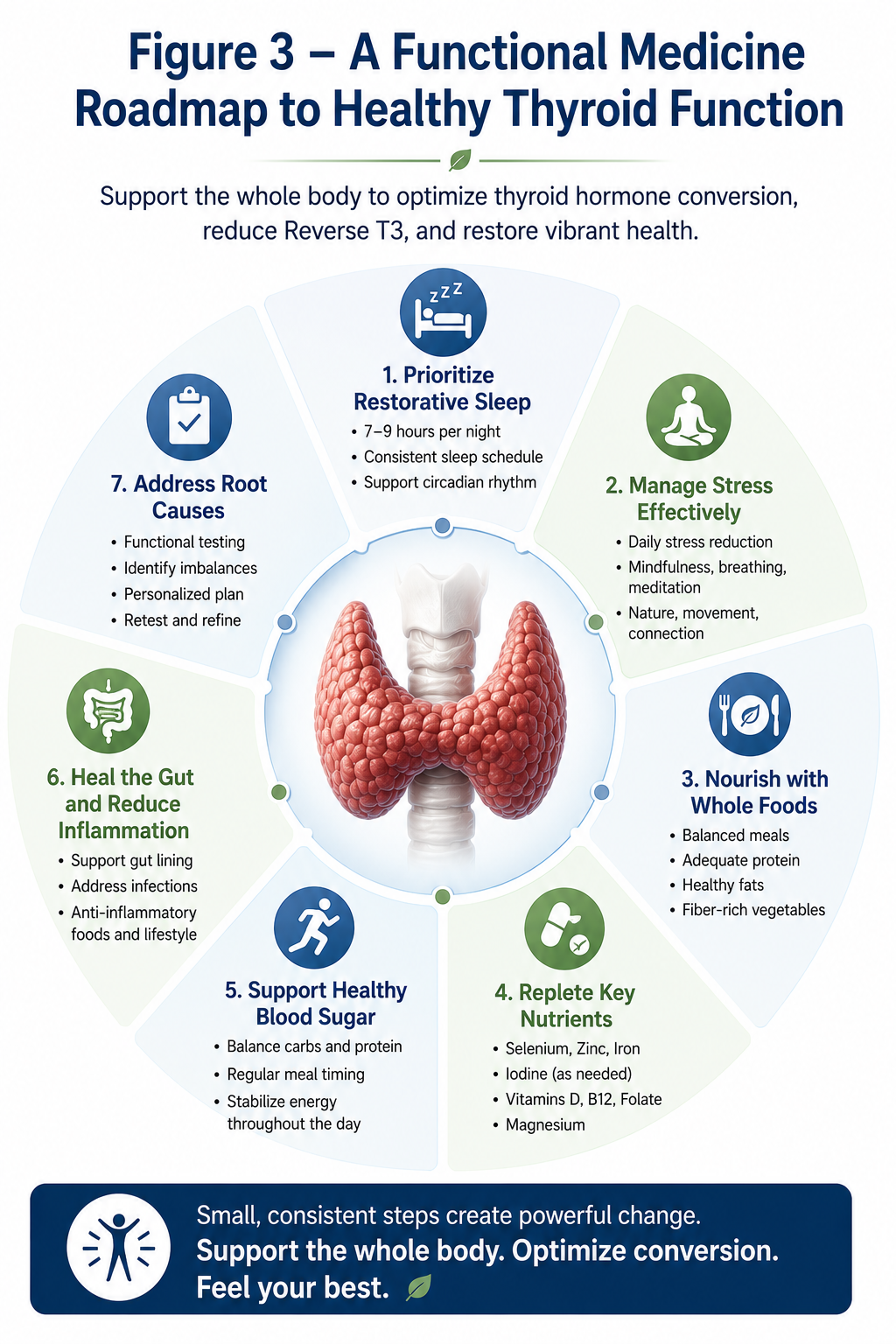
Figure 3. Healthy thyroid function depends on much more than the thyroid gland itself. Sleep, stress management, nutrition, blood sugar regulation, gut health, nutrient sufficiency, and addressing underlying root causes all work together to support healthy thyroid hormone production and conversion.
If you’ve made it this far, you’ve probably realized that Reverse T3 isn’t simply something to fight.
It’s something to understand.
Your body is constantly gathering information from its environment. It pays attention to how well you sleep, the quality of your nutrition, your stress levels, your blood sugar, your gut health, your immune system, and countless other signals. Every day it decides whether conditions are favorable for growth, repair, and energy production—or whether it’s safer to conserve resources.
The encouraging news is that many of those signals can be improved.
One of the first places I encourage patients to begin is with sleep. Deep, restorative sleep is when much of the body’s repair work takes place. Hormones are balanced, tissues recover, inflammation is regulated, and healthy metabolism is supported. If you’re consistently sleeping only five or six hours each night—or waking repeatedly without feeling rested—it’s difficult for any hormone system to perform at its best.
Nutrition is equally important. Your thyroid depends on adequate protein, healthy fats, vitamins, and minerals to produce, convert, and utilize thyroid hormone efficiently. A diet centered around whole, nutrient-dense foods provides the raw materials your body needs while helping stabilize blood sugar and reduce unnecessary metabolic stress. If you’d like to learn more about nutrients that support healthy thyroid physiology, be sure to read my articles on magnesium, vitamin D, and iodine, each of which plays an important role in maintaining metabolic health.
I also encourage patients to think about inflammation. Chronic inflammation doesn’t always cause obvious pain, but it quietly influences nearly every system in the body. Poor gut health, food sensitivities, chronic infections, autoimmune conditions, excess body fat, and highly processed foods can all contribute to an inflammatory environment that places additional demands on the body’s resources. Addressing those root causes is often one of the most meaningful steps toward restoring healthy thyroid function.
Stress deserves just as much attention. We often think of stress as an emotional experience, but your body doesn’t make that distinction. Lack of sleep, chronic pain, blood sugar swings, illness, overtraining, emotional stress, and long work hours all activate many of the same biological pathways. Finding healthy ways to reduce those stress signals—whether through walking, strength training, time outdoors, prayer, meditation, breathing exercises, or simply creating more margin in your schedule—can have a profound impact on overall health.
Finally, don’t overlook the importance of a comprehensive evaluation. Healthy thyroid function depends on much more than the thyroid gland itself. Nutrient deficiencies, digestive disorders, liver health, autoimmune disease, hormone imbalances, and metabolic dysfunction can all influence how thyroid hormones are produced, converted, and utilized. Looking at the whole picture often reveals opportunities for improvement that a single laboratory test simply cannot.
The goal isn’t perfection.
It’s progress.
Healing rarely happens because of one magic supplement or one perfect laboratory result. More often, it happens because dozens of small improvements begin working together. Better sleep supports healthier hormones. Healthier hormones improve energy. Better energy makes regular movement easier. Improved fitness supports healthier blood sugar. Stable blood sugar helps reduce inflammation. Gradually, the body begins moving away from survival mode and back toward normal physiology.
Every positive change sends your body a different message.
Over time, those messages begin changing the conversation taking place inside your body.
And that’s exactly where healing begins.
Looking Beyond the Numbers
If there’s one lesson I hope you take away from this article, it’s this:
Reverse T3 isn’t simply a laboratory value to chase.
It’s a signal.
A clue.
A window into how your body is responding to the world around it.
When Reverse T3 is elevated, your body may be telling you that it doesn’t feel safe enough to maintain full metabolic speed. That message deserves to be explored—not ignored and not oversimplified.
Rather than asking, “How do I lower my Reverse T3?” a better question is, “Why does my body believe it needs to slow down?”
That single question changes the entire conversation.
Instead of treating a number on a laboratory report, we begin looking for the underlying factors that may be influencing thyroid function. Chronic stress, poor sleep, inflammation, gut dysfunction, nutrient deficiencies, insulin resistance, infections, and autoimmune conditions can all play a role. When those root causes are identified and addressed, the thyroid often functions more effectively because the entire body is healthier.
This is one of the guiding principles of functional medicine.
The goal isn’t simply to make laboratory values look better.
The goal is to help people feel better.
Your thyroid doesn’t work in isolation. It is constantly responding to signals from your immune system, digestive tract, liver, adrenal glands, and brain. When those systems become healthier, the thyroid often follows.
Your lab results are part of the conversation.
They’re never the whole conversation.
Dr. Scott’s Perspective
One of the biggest mistakes I see is patients becoming discouraged after hearing that their thyroid tests are “normal.” While laboratory testing is an important part of the evaluation, no blood test can fully capture how you’re feeling or explain every biological process taking place inside your body.
I’ve cared for patients who had textbook laboratory results yet struggled with fatigue, brain fog, weight gain, and other symptoms that significantly affected their quality of life. I’ve also cared for patients with abnormal thyroid markers who felt surprisingly well. That’s why I believe laboratory testing should always be interpreted alongside your symptoms, health history, lifestyle, nutrition, stress levels, and other clinical findings.
Reverse T3 is rarely the entire story.
It’s one piece of a much larger puzzle.
Functional medicine isn’t about finding one magic laboratory test or one perfect supplement. It’s about understanding how the body’s systems work together and identifying the factors that may be preventing normal function. Sometimes the answer is better sleep. Sometimes it’s improving gut health, correcting nutrient deficiencies, reducing inflammation, managing chronic stress, or treating an underlying medical condition. More often than not, meaningful improvement comes from addressing several of these areas together.
If you’d like to explore these topics further, I encourage you to read my articles on
Thyroid and Iodine: Good or Bad?
Magnesium Benefits for Energy, Sleep, Stress, and Heart Health
Natural Strategies for Balancing Hormones in Women Over 40
Together, these articles provide a broader understanding of how nutrition, hormones, inflammation, and lifestyle work together to influence thyroid health.
That’s why I encourage my patients to stop asking, “What’s wrong with my thyroid?” and start asking, “What is my body trying to tell me?”
In my experience, that’s where real healing begins.
Your body is always communicating with you.
The better you understand its signals, the better equipped you’ll be to restore your health—not by fighting your biology, but by working with it.
About Dr. Mark Scott
Dr. Mark Scott is a functional medicine practitioner and chiropractor with more than 25 years of clinical experience helping patients identify and address the root causes of chronic health conditions. His approach combines evidence-based functional medicine, advanced laboratory testing, nutrition, and lifestyle interventions to help patients restore energy, improve metabolic health, and optimize long-term wellness.
At Total Health Center in Virginia Beach, Dr. Scott works with patients experiencing thyroid disorders, digestive problems, autoimmune conditions, hormone imbalances, chronic fatigue, insulin resistance, and other complex health concerns. His goal is to help patients understand not only what is happening in their bodies, but why it is happening—so they can make informed decisions that support lasting health.
If you’re struggling with persistent fatigue, unexplained weight gain, brain fog, or other symptoms despite being told your thyroid tests are “normal,” a comprehensive functional medicine evaluation may help uncover the missing pieces and identify a path toward better health.
References
- Jonklaas J, Bianco AC, Bauer AJ, et al. Evidence-Based Use of Levothyroxine/Liothyronine Combinations in Treating Hypothyroidism. Thyroid. 2021.
- McAninch EA, Bianco AC. The History and Future of Treatment of Hypothyroidism. Annals of Internal Medicine. 2016.
- Bianco AC, Kim BW. Deiodinases: Implications of the Local Control of Thyroid Hormone Action. Journal of Clinical Investigation.
- American Thyroid Association. Clinical Practice Guidelines for Hypothyroidism.
- National Institutes of Health Office of Dietary Supplements. Selenium, Iodine, Magnesium, and Vitamin D Fact Sheets.
Frequently Asked Questions
What is Reverse T3?
Reverse T3 (rT3) is an inactive form of thyroid hormone produced when your body converts T4 into Reverse T3 instead of active T3. This process is a normal part of human physiology and can help conserve energy during periods of illness, chronic stress, inflammation, or calorie restriction.
Is Reverse T3 bad?
Not necessarily. Reverse T3 is not inherently harmful. It is part of your body’s natural response to stress and changing metabolic demands. The important question isn’t whether Reverse T3 is elevated, but why your body is producing more of it.
Can you have normal thyroid tests and still have thyroid symptoms?
Yes. Some people continue to experience fatigue, brain fog, weight gain, cold intolerance, and other symptoms despite having a normal TSH. In certain situations, additional testing such as Free T3, Free T4, thyroid antibodies, or Reverse T3 may provide a more complete picture when interpreted alongside your symptoms and medical history.
What causes Reverse T3 to increase?
Reverse T3 may increase during periods of chronic stress, poor sleep, inflammation, infection, calorie restriction, insulin resistance, severe illness, nutrient deficiencies, or other conditions that signal the body to conserve energy. In many cases, elevated Reverse T3 reflects an adaptive response rather than a disease itself.
Should everyone have Reverse T3 tested?
No. Reverse T3 testing is not necessary for everyone and should not replace a comprehensive thyroid evaluation. Whether the test is appropriate depends on your symptoms, medical history, other laboratory findings, and clinical presentation. Your healthcare provider can help determine whether it may provide useful information in your specific situation.
How can I naturally support healthy thyroid hormone conversion?
Supporting healthy thyroid hormone conversion begins with addressing the factors that influence metabolism. Prioritizing quality sleep, managing chronic stress, reducing inflammation, eating a nutrient-dense diet, improving gut health, stabilizing blood sugar, correcting nutrient deficiencies, and maintaining regular physical activity all help create an environment that supports normal thyroid function.
Does Reverse T3 cause weight gain?
Reverse T3 itself is not necessarily the direct cause of weight gain. However, the conditions associated with elevated Reverse T3—such as chronic stress, poor sleep, inflammation, insulin resistance, and reduced metabolic activity—may contribute to difficulty maintaining a healthy weight.
What is the functional medicine approach to Reverse T3?
Rather than focusing solely on lowering Reverse T3, functional medicine looks for the underlying reasons the body may be slowing metabolism. This includes evaluating lifestyle factors, nutrition, gut health, inflammation, hormone balance, autoimmune conditions, and other root causes that may be affecting thyroid hormone production, conversion, and cellular function.