

What Happens When You Stop Eating?
The Remarkable Healing Intelligence of Fasting
For most of human history, people did not eat three meals a day with snacks in between.
Food availability changed with the seasons, the success of a hunt, the quality of a harvest, and simple circumstance. Sometimes there was abundance. Sometimes there wasn’t.
The remarkable part is that the human body did not simply break down when food became scarce.
It adapted.
Over thousands of generations, we developed remarkable metabolic systems that allowed us to move between periods of feeding and periods without food. Today we call that second state fasting, but fasting is much more than simply skipping meals.
When food is plentiful, the body receives a powerful message that nutrients are available. Insulin rises, digestion becomes active, energy is stored, and growth pathways turn on. The message is simple:
Build. Store. Grow.
When food temporarily disappears, that message gradually changes. The body begins accessing stored energy, insulin falls, fat becomes increasingly available, ketones rise, and nutrient-sensing pathways begin to shift.
The message becomes:
Mobilize. Conserve. Recycle. Adapt.
Neither state is better. The human body was designed to experience both.
The problem is that modern life has largely eliminated one of them.
We Live in a World Our Metabolism Never Expected
Our ancestors did not have refrigerators stocked with food, convenience stores open twenty-four hours a day, or snacks available from the moment they woke until the moment they went to bed.
Human metabolism evolved expecting a rhythm of feeding and fasting.
Today, many of us wake up and eat breakfast, enjoy a midmorning snack, have lunch, grab something in the afternoon, eat dinner, enjoy dessert, and perhaps snack again before bed. For much of the population, the body receives a nutrient signal almost continuously throughout the day.
There is nothing inherently wrong with eating. Digestion, absorption, and nourishment are essential to life. But every meal tells the body that food is abundant. Hormones respond, digestion accelerates, nutrients are stored, and growth pathways remain active.
Fasting tells a different story.
As insulin falls and stored fat becomes available, the body gradually shifts away from processing incoming food and begins using the energy it has been storing all along. Ketones begin rising, growth hormone changes, and cellular maintenance pathways receive new signals.
Perhaps one of the greatest metabolic mismatches of modern life is not what we eat.
It is that we rarely give our metabolism an opportunity to experience the other half of the cycle.
We didn’t lose our ability to fast.
We lost the opportunity to fast.
Continue Learning: If you’re interested in how functional medicine looks beyond symptoms to understand why disease develops, explore our guide to Functional Medicine:
Fasting Is Older Than Medicine
Long before scientists discovered insulin, ketones, mitochondria, or autophagy, people noticed something fascinating about the body.
Many animals instinctively eat less when they are injured or sick. Humans often experience the same loss of appetite during illness.
That response is not always beneficial. During serious illness or injury, proper nutrition can be essential for recovery. But the instinct itself raises an interesting question.
Why would evolution preserve a temporary loss of appetite during periods of physical stress?
One possibility is that the body is changing priorities. Less energy is devoted to searching for food, digesting it, absorbing it, and storing it, while more attention can be directed toward survival, adaptation, immune activity, and maintenance.
Ancient healing traditions noticed similar patterns thousands of years ago. Ayurvedic medicine developed the concept of langhana, a practice that can include periods of reduced food intake or fasting. Fasting also became woven into Christianity, Judaism, Islam, Buddhism, Hindu traditions, and many other cultures around the world.
Different civilizations explained fasting in different ways, yet the same idea continued appearing throughout history:
Sometimes the body—and perhaps the mind—benefits from a period of less rather than more.
Modern science is finally giving us the tools to study what those ancient observers could only witness. Today we can measure insulin, watch ketones rise, study growth hormone, investigate autophagy, and examine cellular repair pathways.
We are beginning to understand why fasting has remained part of the human experience for thousands of years.
And that brings us to the really interesting question:
What actually happens when we don’t eat for 24 hours…36 hours…48 hours…72 hours…or even several days?
The Biology of a Five-Day Fast
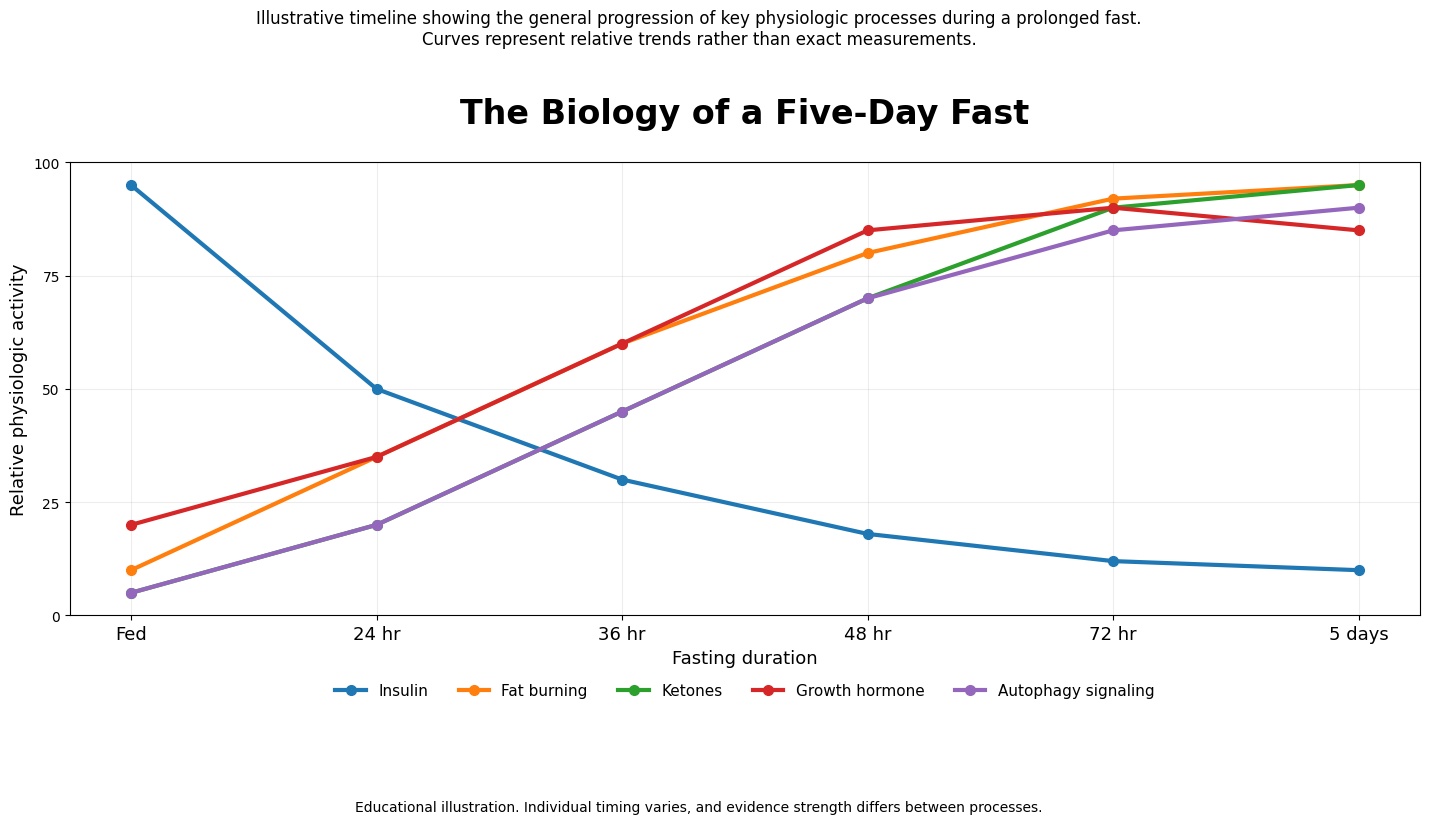
Illustrative timeline showing the relative progression of key physiologic processes during a prolonged fast. Curves represent conceptual trends rather than exact measurements.
Illustrative timeline showing the general progression of insulin, fat burning, ketones, growth hormone, and autophagy signaling from the fed state through five days of fasting. Curves represent relative trends rather than exact measurements.
The timeline is best viewed as a roadmap rather than a stopwatch. Age, body composition, activity level, metabolic health, medications, carbohydrate intake, and previous fasting experience can all influence how quickly someone moves through these stages.
The exact hour matters less than the direction. The longer food remains absent, the more completely the body shifts from processing incoming nutrients toward using stored fuel and activating the metabolic programs associated with fasting.
24 Hours
The Metabolic Switch Begins
At roughly twenty-four hours, the biggest change taking place is not dramatic fat loss or some mythical detoxification event.
The most important change is that your body is beginning to switch fuel sources.
During the first day, the liver gradually uses its stored glycogen to help maintain normal blood sugar. As those stores decline, insulin falls and fat cells begin releasing more fatty acids into the bloodstream. Ketone production starts increasing, although the transition is still in its early stages.
Imagine driving a hybrid vehicle. For the first part of the trip, one energy source does most of the work. Then, almost seamlessly, another system begins taking over.
Your metabolism works much the same way.
Rather than running out of fuel, it simply begins using a different fuel tank.
One of the biggest surprises for many people is that hunger does not continue getting stronger hour after hour. Hunger often arrives around normal meal times, then gradually fades away again.
For many people, this is the first realization that hunger and emergency are not the same thing.
Your body is learning to trust the energy it has already stored.
Why This Matters
The first day of fasting begins restoring something many people have lost without realizing it: metabolic flexibility.
A healthy metabolism should be able to use incoming food when it is available and stored energy when it is not.
Modern abundance has simply given us fewer opportunities to practice the second half of that equation.
36 Hours
Your Body Starts Looking Inward
By the second day, the transition becomes much more noticeable.
Fat burning has increased significantly. Ketone production continues climbing, and the brain begins using those ketones as an increasingly important fuel source.
Many experienced fasters describe this stage as surprisingly calm. Instead of thinking constantly about food, they often notice steadier energy and improved mental clarity. Not everyone experiences this, but it has become one of the most commonly reported observations during longer fasts.
Researchers have become interested in this stage for another reason.
When nutrients are constantly available, cells receive powerful signals to grow and build. As fasting continues, those signals begin changing. Nutrient-sensing pathways shift toward conservation and maintenance, creating an environment that appears to favor cellular housekeeping and repair.
The body is no longer simply burning stored energy.
It is reorganizing its priorities.
Why This Matters
The second day is often where people stop thinking of fasting as simply “not eating.”
Instead, they begin appreciating it as a completely different metabolic state—one that our ancestors likely experienced far more often than we do today.
Continue Learning: Many of these same metabolic principles influence digestive health, inflammation, and the gut microbiome. Learn more in Functional Medicine & Digestive Health:
48 Hours
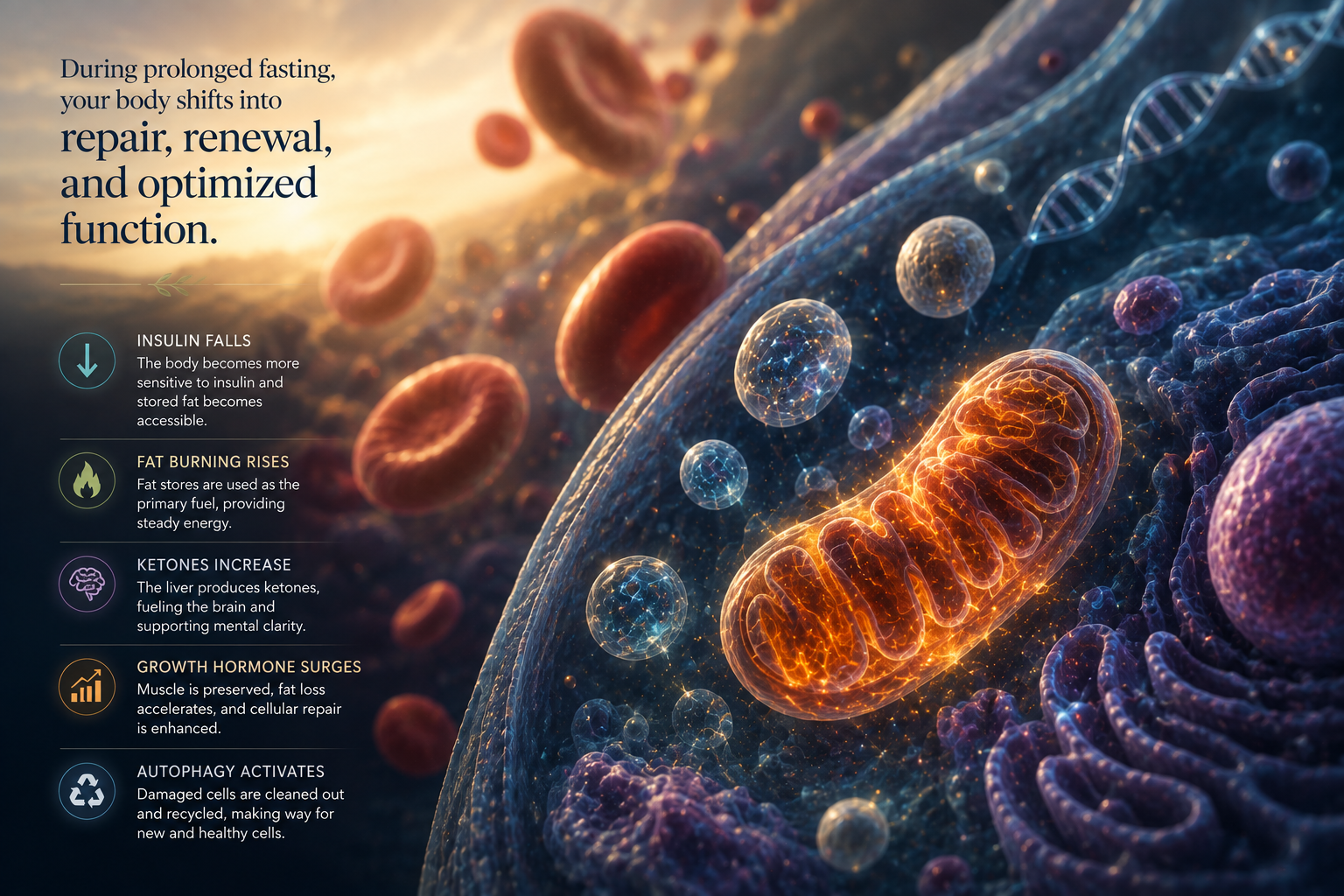
Prolonged fasting shifts the body from storing energy toward mobilizing fat, increasing ketones, altering hormone signaling, and activating cellular maintenance pathways such as autophagy.
This Is Where Fasting Gets Really Interesting
At approximately forty-eight hours, several of fasting’s most fascinating adaptations begin overlapping.
Fat burning is high. Ketones have risen substantially. Insulin remains low. Nutrient-sensing pathways have shifted, and the body’s priorities are moving farther away from constant storage and growth.
Then there is growth hormone.
This may be one of fasting’s most underappreciated adaptations.
Human research has shown that short-term fasting can produce a dramatic increase in growth-hormone secretion. That does not mean fasting suddenly turns into a muscle-building program. In the fasting state, growth hormone appears to serve a very different purpose.
It helps mobilize fat and may help protect valuable lean tissue while the body adapts to the temporary absence of food.
That is a remarkable survival strategy.
Instead of immediately breaking down muscle for energy, the body increasingly turns toward the fuel source it was designed to store for exactly this circumstance: body fat.
Ketones become part of that strategy as well. The more effectively the brain can use ketones, the less glucose it needs. That reduces some of the pressure to manufacture glucose from amino acids and helps explain why humans can tolerate periods without food far better than a simple calorie equation might suggest.
Autophagy: The Cellular Recycling System
This is also where the discussion of autophagy becomes especially interesting.
Autophagy is the process cells use to identify, break down, and recycle damaged proteins and worn cellular components. Think of it as an internal maintenance crew.
When food and nutrients are constantly available, the body receives strong signals to build. During fasting, those nutrient signals decline, creating conditions that appear to favor cellular recycling and maintenance.
Scientists are still working to determine exactly how strongly autophagy increases in different human tissues and at what point during a fast it becomes most significant.
That uncertainty does not make autophagy unimportant.
It simply means the biology is more complex than saying, “Autophagy starts at exactly thirty-six hours.”
What we can say is that fasting creates one of the body’s most powerful natural environments for shifting away from constant growth and toward cellular maintenance.
Why This Matters
At forty-eight hours, fasting begins looking less like simple food restriction and more like a coordinated biological adaptation.
Fat is being mobilized, ketones are feeding the brain, growth hormone has changed dramatically, insulin remains low, and cellular repair and recycling pathways are receiving stronger signals.
The body is not shutting down.
It is reorganizing.
Dr. Scott’s Perspective
This is one of the reasons I find fasting so fascinating.
We often talk about health as though the body always needs something added to it—a supplement, a medication, a treatment, another meal.
Sometimes the body may need something completely different.
Sometimes it may benefit from enough time without incoming food to let older biological programs become more active.
72 Hours
Deep Adaptation
By the third day, the body is no longer transitioning into fasting.
It is fasting.
Fat has become the dominant energy source for much of the body, and ketones have become a significant fuel for the brain.
This shift is important because ketones are more than simply emergency fuel. Researchers increasingly recognize ketones as signaling molecules capable of influencing gene expression, oxidative stress, inflammation, mitochondrial function, and cellular resilience.
That is one reason prolonged fasting has attracted so much attention in metabolic and longevity research.
At this stage, researchers also begin seeing broader changes in immune and cellular signaling. That does not mean a three-day fast magically “resets” the immune system, but it does suggest that the immune system is actively responding to the fasting environment.
Where Stem Cells Enter the Conversation
This is also where some of the most exciting fasting research begins.
Animal research and early human-context studies have suggested that prolonged fasting followed by refeeding may influence stem and progenitor-cell signaling, particularly in the blood and immune system.
This is an area where we should be both curious and careful.
We cannot honestly say that a seventy-two-hour fast regenerates the entire immune system or creates new organs.
But we can say that researchers are studying something genuinely fascinating: periods of nutrient scarcity appear capable of changing the environment in which regenerative cells operate.
That may be important because fasting suppresses growth-related signals such as insulin and IGF-1.
Then food returns.
The hormonal environment changes again.
Growth resumes.
Repair becomes possible.
The transition itself may be part of the benefit.
Why This Matters
By three days, fasting has become a whole-body event.
Energy metabolism has changed. Hormonal signaling has changed. Immune activity changes. Cellular stress-response systems are active. Scientists are also beginning to investigate whether the return to feeding may help translate some of those changes into renewal.
Ancient traditions could observe the effects.
Modern science is beginning to see the machinery underneath.
Four Days
The Body Is Fully Committed
By the fourth day, there may not be an entirely new metabolic switch waiting to flip.
Instead, the changes that began earlier have become deeply established. Insulin remains low, fat burning stays high, and ketones remain elevated as the body continues conserving glucose for the tissues that still require it while relying heavily on fat and ketones elsewhere.
At the same time, the body is balancing another priority: preserving itself. Growth hormone, ketone adaptation, reduced glucose requirements, and changes in other hormonal pathways all appear to help reduce the rate at which valuable tissue must be broken down.
That does not mean there is no lean-tissue loss during prolonged fasting. There is. The body is simply doing everything it can to use stored energy intelligently.
This stage also teaches an important lesson about health. Growth is necessary. Insulin is necessary. Protein synthesis is necessary. The pathways activated by food are not bad.
The fascinating part is that the body also appears to benefit from periodically experiencing the opposite state.
Nature is full of these rhythms. Day and night. Activity and rest. Feeding and fasting. Building and maintenance.
Perhaps health depends less on staying in one perfect state and more on maintaining the ability to move between them.
Five Days
The Fast Is Only Half the Story
By five days, prolonged fasting has created a metabolic state that many people living in modern abundance may never experience.
Ketones remain high, insulin remains low, and stored fat is supplying much of the body’s energy. Growth-related signals have been reduced for days, while pathways associated with stress resistance and cellular maintenance have had an extended period without incoming nutrients.
But this is where I think the conversation about fasting often stops too early.
The most interesting question may not be what happens on day five.
It may be what happens when you eat again.
Cleanup Is Not the Same as Rebuilding
Think about renovating a house.
Before you rebuild, you may need to shut things down, remove damaged material, clean up what is no longer useful, and prepare the foundation. But demolition is not renovation. Eventually, the building materials have to arrive.
That is where refeeding becomes important.
During fasting, insulin and growth signaling are suppressed while maintenance and stress-response pathways become more prominent. When nutritious food returns, the message changes again. Amino acids return, insulin rises, protein synthesis resumes, and growth pathways reactivate.
The body moves from maintenance back toward rebuilding.
Some of the most intriguing fasting research suggests that this fasting-refeeding cycle may be as important as the fasting period itself. The fast may create the maintenance signal. The refeed may create the rebuilding signal.
Clean up. Then rebuild.
That may be one of the most useful ways to think about the entire process.
Longer Is Not Always Better
If fasting activates interesting biology, it is tempting to assume that a longer fast must always be better.
That is not the lesson.
The body needs fasting signals, but it also needs nourishment. Protein matters. Minerals matter. Essential fats matter. Vitamins matter. Food matters.
Longer fasting also creates more tradeoffs. Blood pressure can fall, electrolytes can shift, exercise performance may decline, uric acid can increase, and some lean tissue is lost. Medications may also behave differently when someone is not eating.
There is no prize for reaching five days.
For one person, a regular overnight fasting window may provide meaningful benefit. Another may occasionally choose a twenty-four-hour fast. Some experienced and appropriate individuals may explore thirty-six- or forty-eight-hour fasting. Multi-day fasting is a different category and deserves more thought, preparation, and medical awareness.
The goal is not deprivation.
The goal is metabolic rhythm.
The Bigger Lesson
Fasting is sometimes described as a modern health trend, but there is almost nothing modern about it.
Periods without food existed long before supermarkets. Animals experienced feeding and fasting long before humans learned to measure metabolism. Religious and healing traditions practiced fasting thousands of years before scientists discovered insulin.
What is new is our ability to look inside the body and begin understanding what may have been happening all along.
We can watch insulin fall, measure ketones rise, study growth hormone, investigate autophagy, examine immune signaling, and begin asking whether fasting and refeeding influence regenerative pathways in ways that previous generations could only observe from the outside.
Science has not answered every question.
It should not have to before we are allowed to find the questions fascinating.
The larger lesson is that the human body possesses an extraordinary ability to change priorities when its environment changes. In abundance, it can build. In scarcity, it can adapt.
When food disappears temporarily, the body does not simply sit there waiting for the next meal. It changes fuel sources, reorganizes hormones, conserves valuable tissue, alters cellular signaling, and activates maintenance programs that most of us rarely experience in a world where food is always available.
Fasting does not give the body a new ability.
It gives the body an opportunity to use abilities it already has.
And in a world built around constant abundance, that opportunity may be more important than we realize.
A Final Word About Longer Fasting
Fasting is not appropriate for everyone. Pregnancy, breastfeeding, eating disorders, frailty, certain chronic illnesses, diabetes medications, blood-pressure medications, and other circumstances can make prolonged fasting inappropriate or potentially dangerous.
A twenty-four-hour fast and a five-day fast are also not the same intervention. As fasting duration increases, so does the importance of hydration, electrolytes, medication considerations, individual health status, and thoughtful refeeding.
The purpose of this article is not to convince everyone to complete a prolonged fast.
It is to help you understand why fasting is biologically fascinating, why the body responds so differently when food disappears for an extended period, and why periodically giving the body time without incoming food may be very different from simply “not eating.”
Key Takeaways
- Your body was designed to experience both periods of eating and periods without food. Modern life has largely eliminated the fasting half of that natural rhythm.
- During the first 24 hours, your metabolism begins shifting from stored carbohydrates to stored fat as insulin falls and fat burning increases.
- Between 36 and 48 hours, ketone production rises significantly, growth hormone increases, and the body shifts further toward maintenance and adaptation.
- Prolonged fasting creates an environment that supports cellular recycling processes such as autophagy, although the timing and degree vary between individuals and tissues.
- Research suggests that fasting influences many biological systems—including metabolism, hormones, immune signaling, and mitochondrial function—but scientists continue to study exactly how these changes translate into long-term health benefits.
- The return to eating is just as important as the fast itself. Nutritious refeeding provides the building blocks needed for recovery and renewal.
- Longer fasting is not always better. The goal is not deprivation—it is restoring metabolic flexibility and allowing the body to periodically use the biological programs it evolved to perform.
- Extended fasting is not appropriate for everyone. Individuals with certain medical conditions or those taking medications should consult a qualified healthcare professional before attempting prolonged fasting.
About Dr. Scott
Dr. Mark Scott has been helping patients improve their health since 1997 through an integrative approach that combines functional medicine, chiropractic care, nutrition, and lifestyle medicine.
Rather than simply treating symptoms, Dr. Scott focuses on identifying and addressing the underlying causes of chronic health problems. His clinical interests include thyroid disorders, digestive health, metabolic dysfunction, autoimmune conditions, hormone balance, and healthy aging.
Fasting is one of many lifestyle tools that may help support metabolic health. When appropriate, Dr. Scott works with patients to determine whether therapeutic fasting fits safely into their personalized health plan alongside nutrition, laboratory testing, and other evidence-informed strategies.
Learn more about Functional Medicine:
Frequently Asked Questions
Is a 24-hour fast safe for most healthy adults?
Many healthy adults can tolerate an occasional 24-hour fast, but individual circumstances vary. Certain medical conditions, medications, pregnancy, breastfeeding, and a history of eating disorders may make fasting inappropriate. When in doubt, consult your healthcare provider.
What is the biggest benefit of a 48-hour fast?
Many researchers consider the 48-hour mark particularly interesting because fat burning, ketone production, hormonal changes, and cellular maintenance pathways become more pronounced than during shorter fasts. Individual responses, however, vary considerably.
Does fasting burn muscle?
During shorter fasts, the body preferentially increases fat utilization while several hormonal adaptations help conserve lean tissue. Longer fasts can lead to some lean tissue loss, which is one reason extended fasting should be approached thoughtfully.
What is autophagy?
Autophagy is the body’s natural cellular recycling process. Cells identify damaged or unnecessary components, break them down, and recycle their building blocks. Fasting appears to promote conditions that favor autophagy, although scientists continue to study exactly when and where it is most active in humans.
Does fasting increase growth hormone?
Yes. Studies have shown that growth hormone secretion increases during fasting. During a fast, its primary role appears to be supporting fat mobilization and helping preserve lean tissue rather than building new muscle.
Are ketones only important for people following a ketogenic diet?
No. Ketones are produced naturally during fasting as the body shifts toward using stored fat for fuel. They also serve as signaling molecules that researchers believe influence several important biological processes.
Can fasting improve mental clarity?
Many people report improved focus and mental clarity during extended fasting, particularly after the body becomes adapted to using ketones. While this is a common experience, responses differ from person to person.
What should I eat after a prolonged fast?
Breaking a prolonged fast with a balanced, nutrient-dense meal is generally more comfortable than eating a very large meal immediately. Hydration and electrolytes are also important, especially after longer fasts.
Is longer always better?
No. The purpose of fasting is not to see how long you can avoid food. The goal is to use fasting strategically to support metabolic health while maintaining adequate nutrition over the long term.
Can fasting replace a healthy diet?
No. Fasting and good nutrition work together. A nutrient-dense diet provides the building blocks for health, while appropriate fasting allows the body to periodically shift into a different metabolic state. Neither replaces the other.